Pechiparai Dam: the reservoir that decides whether Thirparappu flows
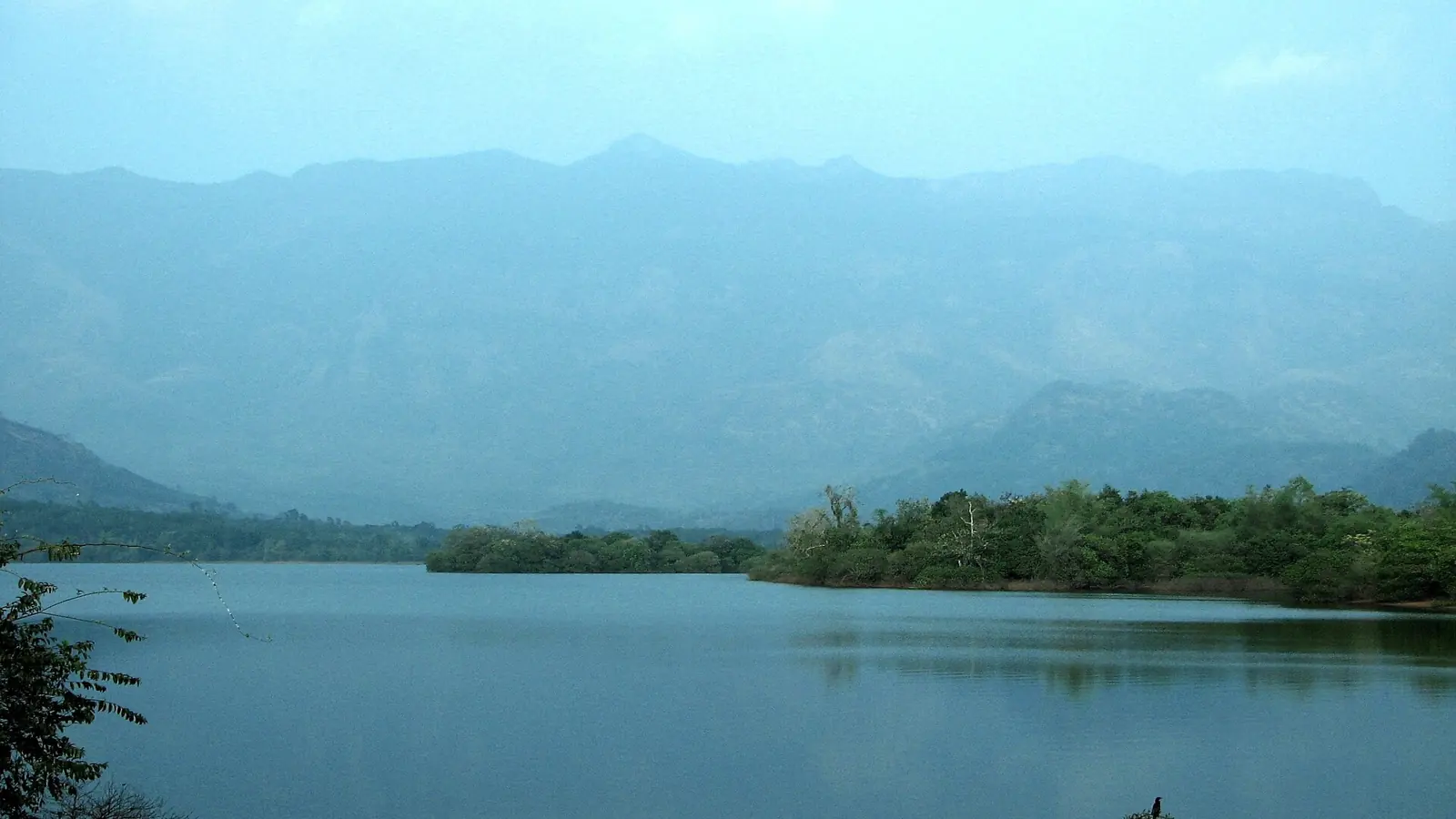
Pechiparai is where the water for the western half of the district is stored, and every waterfall and canal you visit downstream depends on what happens here. The dam was completed in 1906 under the Travancore government, a low masonry wall about 425 metres long across the Kodayar river where it leaves the Western Ghats. It is not a spectacular structure. What you come for is the reservoir behind it, a wide sheet of water backed by forested hills that rise straight out of the far shore, and the fact that on a weekday afternoon you may share it with a dozen people and a fishing coracle.
The dam is 60 km from Kanyakumari, about 12 km past Thirparappu Falls on the Kulasekharam road, and is the last comfortable stop before the ghat road climbs to Upper Kodayar. There is a small laid-out garden below the dam wall with lawns, a children’s play area and a viewpoint on the bund, and rowing and pedal boats run from a jetty on the reservoir when the level allows. Entry to the garden is ₹10, boating costs ₹100 to ₹150 a person for about twenty minutes, and the whole visit takes an hour. Come in October to January for a full reservoir and green hills; come in May and you will be looking at a wide band of cracked red mud.
What you actually see at Pechiparai
The visit splits into three short parts. First is the walk along the top of the dam, which is open to the public along a railed path for most of its length. From the middle you look one way over the reservoir into the hills, and the other way down onto the garden and the Kodayar as it leaves the sluices. The shutters themselves are old iron gates on hand-wound gear, still operated by the Public Works Department, and if you are here in the early morning between June and December you may see the day’s release opened, which is the water that arrives at Thirparappu two hours later.
Second is the garden below the wall. It is a government garden of the familiar type: clipped lawns, painted concrete animals, a fountain that works some days, swings and a slide, and enough shade under old rain trees to sit through a picnic. It is tidy, and it is where families spend most of their time. Third is the reservoir edge itself. Walk along the bund past the boating jetty and the shoreline turns to laterite and scrub, with kingfishers and cormorants on the dead trees standing in the water, and the noise of the garden falls away. This is the best part and almost nobody does it. Bring binoculars if you have them; between November and February there are migrant ducks on the far side of the water.
Boating: what is on offer and when it runs
The boating counter is on the reservoir side of the dam, reached by a path from the garden. Pedal boats for two or four cost ₹100 a head and rowing boats with a boatman cost ₹150 a head, both for roughly twenty minutes, and there is a larger motor launch that runs when a group of ten or more books it together. Life jackets are handed out and the boatmen do insist on them. The water near the jetty is deep and cold, and the launch goes far enough out for the dam wall to shrink and the hills to fill your view, which is the moment most people remember.
The honest limitation is that boating runs only when the level is right and the weather is calm. When the reservoir is low in April and May the jetty is a long way from the water and the service stops. When the shutters are open for a heavy release, or during rain, it also stops. In practice that means boating is dependable from about October to February and a gamble the rest of the year. The counter shuts at 4:30 pm, and on Sundays in season the queue builds from 2 pm. If boating is the point of your trip, call before you drive and aim for a weekday. If it is not running, Chittar Dam, 25 km away, is a fallback with a similar set-up and a slightly more reliable service.
Which months the reservoir is worth seeing
The reservoir fills on two monsoons. The south-west monsoon from June brings the first big inflow from the hills, and by August the water is up against the bund. The north-east rains in October and November top it up again, so from October to January the reservoir is at its widest and the surrounding hills are at their greenest. This is the window to come. December mornings can have mist lying on the water until 8 am, which is worth an early start if you are staying in Nagercoil.
From February the level starts to drop as irrigation releases run ahead of inflow, and by April there is a broad shelf of exposed bed around the edges. In a poor year the reservoir in May is a lake in the middle of a red plain, the boating has stopped, and the garden is the only thing operating. It is not a wasted trip if you are already at Mathur or Thirparappu, but it is not something to drive 60 km for on its own. One more caution: in the heaviest spells of the north-east monsoon, usually a few days in November, the dam road is closed to visitors while the shutters are fully open, and the ghat road beyond towards Kodayar shuts too. Our drivers check with the Kulasekharam stand before setting out on those days.
Getting there and combining it with the western circuit
From Kanyakumari the road runs through Nagercoil to Kulasekharam, then continues past the Thirparappu turning to Pechiparai village and the dam, about 60 km and an hour and a half. The last stretch is a good tarred road through rubber estates. Parking is on the approach below the garden, ₹30 for a car, and fills only on holidays. Buses run from Nagercoil to Pechiparai via Kulasekharam roughly every half hour and cost about ₹45; the stop is a five-minute walk from the garden gate.
Pechiparai rarely justifies a day on its own. The sensible plan is the western circuit: Padmanabhapuram Palace first at 9 am, Thirparappu Falls for a swim, lunch in Kulasekharam, Pechiparai for an hour in the early afternoon, then Mathur Aqueduct at 3:30 when the valley is in shade, and back to Kanyakumari by 6:30. That is around 150 km and costs ₹2,800 in a sedan or ₹4,200 in an Innova Crysta for the day, with fuel, tolls, parking and the driver included. If you are heading up the ghat to Upper Kodayar, Pechiparai is where you stop for a last cup of tea and where the forest checkpost is, so it happens naturally. A good simple lunch is available in Kulasekharam at several meals hotels for about ₹130 a plate; Pechiparai village itself has only tea shops.
Is it worth your time, honestly
Pechiparai is a pleasant hour, not a destination. If you are comparing it against the other stops in the west, the palace is more interesting, Thirparappu is more fun for children, and Mathur is more striking. Pechiparai wins on one thing: quiet. On a weekday afternoon in December the reservoir is still, the hills are dark green, and there is nowhere else this close to Kanyakumari that feels so far from the coast. Couples, older travellers and anyone who wants to sit down for half an hour after a morning of temples and palaces will appreciate that.
Families with children get the play area, the boat ride and a lawn, which is a reasonable exchange for an hour but will not carry a whole afternoon. Photographers should come for the first hour after opening or the last before closing; midday light on flat water is unkind. Do not come expecting a spectacle from the dam itself, which is a low old wall with iron gates, and do not come in April or May expecting to boat. If you have only one day in the district, this drops off the list; it belongs on the second day of our 3 days 2 nights itinerary, when the coast is done and the hills are the point.
Six things our drivers tell every guest
- October to January is the season. The reservoir is full, the hills are green and the boating runs every day.
- Walk the bund beyond the boating jetty. The shoreline scrub is where the birds are and the garden noise disappears.
- Boating stops when the level is low, when it rains, or when the shutters are open. Ring ahead if it is the point of the trip.
- Eat in Kulasekharam before you arrive. Pechiparai village has only tea shops.
- On heavy-rain days in November the dam road closes to visitors. Check with your driver that morning.
- Fit it between Thirparappu and Mathur on a western-circuit day rather than driving 60 km for it alone.
How to get here
Pechiparai Dam is 60 km from Kanyakumari town, 1 hr 30 min. It is included in our 3 days 2 nights package and our family tour package, or we can add it to any local sightseeing day by the hour.
Questions about Pechiparai Dam
Nearby places to add to the same day
 55 km
55 kmA broad 50 ft curtain on the Kodayar river, 55 km west. Strong June to January, often dry in summer.
Thirparappu Falls is 55 km from Kanyakumari and flows strongly June to January. Entry ₹10, open 8 am to 6 pm. We say which months it runs dry.
 65 km
65 kmKodayar Falls
Kodayar Falls is 65 km from Kanyakumari up a forest ghat road. Twin falls, checkpost open 7 am to 3 pm, best July to December. Permit rules explained.
 60 km
60 kmMathur Aqueduct
Mathur Aqueduct is 60 km from Kanyakumari, 115 ft high and about 1 km long. Entry ₹10, open 9 am to 6 pm. How to walk the trough and when it is empty.
Want Pechiparai Dam at the right hour?
We know when the queue is short and when the light is good. One message and it is in your plan.