
A Kanyakumari itinerary built for classrooms, not just cameras
Amman Temple → Vivekananda Rock → Wind Farm → Vattakottai → Tsunami Memorial
Price for the whole vehicle, not per head
Printed, not hiddenSchool and college groups have a different set of problems than a family of four, and most of them are logistical rather than scenic. Forty students need one point of contact, not a driver who disappears between stops; a headcount at every departure, not an honour system; and a bus or Tempo Traveller that can actually park near the site rather than a kilometre away. We run this package with a single coordinator who stays with the group for both days, confirms numbers before each move, and carries a printed itinerary the accompanying teachers can check against.
The stops themselves are chosen for what a syllabus actually covers rather than what photographs well. The Muppandal wind farm is a working lesson in renewable energy at a scale textbooks describe but rarely show; the tsunami memorial is a genuine entry point for a class discussion on coastal disaster preparedness, not just a monument; Gandhi Mandapam ties directly into the freedom movement chapter most Tamil Nadu boards teach around class 8 to 10. The confluence point itself, where the Arabian Sea, Bay of Bengal and Indian Ocean are said to meet, is a standing geography lesson we let the teacher lead rather than talk over.
Pricing runs per vehicle rather than per head, which is simpler for a bursar to reconcile, and we quote in advance rather than adding charges on the day. A Tempo Traveller suits 12 to 16 students with two staff; larger batches need either a second vehicle or our bus partner, quoted separately at ₹38 a kilometre. Institutions booking three or more vehicles get a fixed group rate rather than three separate quotes.
What this trip includes
- One coordinator for the whole trip, not a rotating driver roster
- Roll-call headcount at every stop, checked against the school’s list
- Muppandal wind farm as a live renewable-energy lesson, not a drive-past
- Tsunami memorial and Gandhi Mandapam tied to the history and science syllabus
- Compulsory life jackets on the ferry, no exceptions for any student
- One invoice per vehicle, payable against a school purchase order
Day-by-day itinerary
Arrival, the Amman temple and the town memorials
- Pick-up from the railway station, bus stand or school-arranged point
- Roll-call and safety briefing before the first stop
- Bhagavathy Amman Temple, phones and cameras left with the coordinator
- Gandhi Mandapam and the Kamaraj Memorial, with a short history talk
- Tsunami memorial, an unhurried stop rather than a rushed photograph
- Check-in at the group accommodation, dinner and an early night
The ferry, the wind farm and the fort
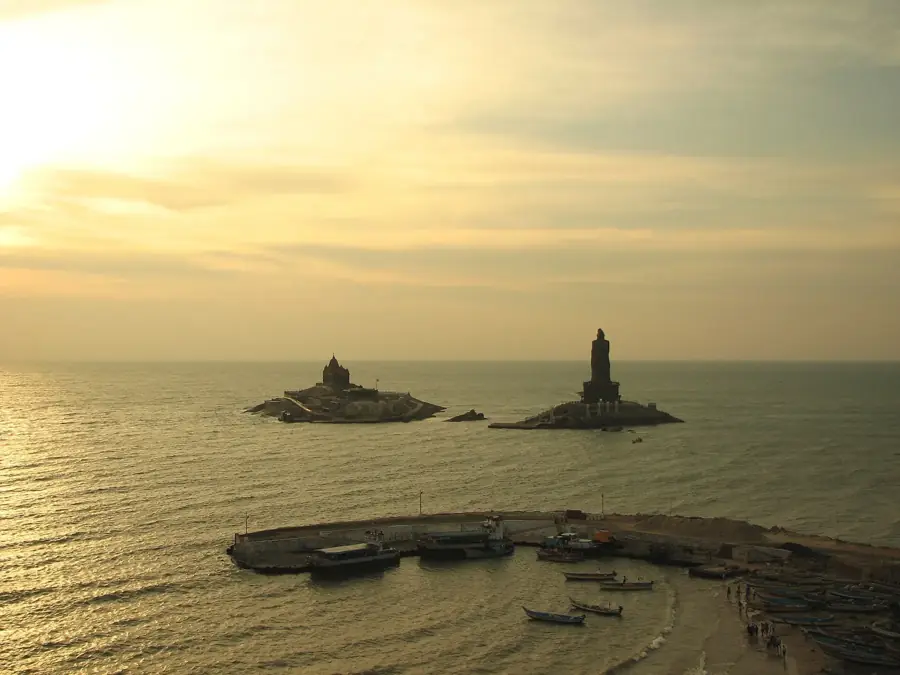
- Ferry to Vivekananda Rock in batches of about twenty, life jackets compulsory
- Glass bridge crossing, staff member assigned to each batch
- Muppandal wind farm — late morning, when the sea breeze is reliably up
- Vattakottai Fort, ramparts walk with a headcount at the gate
- Lunch stop, then the return journey
Included
- Tempo Traveller (or bus on request) for two days with one overnight halt
- Driver, fuel, all tolls, parking and permits
- One dedicated group coordinator for the full two days
- Roll-call headcount management at every stop
- Life jackets arranged and enforced at the ferry crossing
- Single invoice against a school purchase order or advance transfer
- A first-aid kit carried in the vehicle
- Written itinerary supplied to accompanying teachers in advance
Not included
- Group accommodation and all meals
- Ferry and glass bridge tickets, about ₹75 to ₹115 per student
- Temple, fort and memorial entry tickets where applicable
- Kilometres beyond 250 km, at ₹24 per km for a Tempo Traveller
Why one coordinator and a paper roll-call, not an app
The single biggest complaint we hear from teachers about other operators is a headcount that goes wrong somewhere between the bus and the boat. We fix this with one coordinator assigned to the whole group for both days, not a rotating driver roster, and a paper roll-call at every departure point — the temple, the ferry jetty, the wind farm gate — checked against the list the school gave us at booking. It adds two minutes at each stop and it has never once cost a group its schedule.
We also ask for a single teacher to be named the point of contact before the trip starts, and our coordinator reports to that person directly rather than making decisions independently. If a student falls sick or a parent calls with a change, it goes through one channel. For groups with a genuinely large staff-to-student ratio, this matters less; for a typical school outing with two or three teachers for forty students, it is the difference between a manageable day and a stressful one.
Stops chosen for the syllabus, not just the photograph
The Muppandal wind farm is one of Asia’s largest onshore installations and it is a genuinely useful stop for a physics or environmental science class, not just a drive-past. We park where the turbines are close enough to hear, and our coordinator can point out the transmission lines and substation if a teacher wants to extend the point into grid infrastructure. It works best in the late morning, when the sea breeze that turns the blades is reliably up; by evening the wind often drops.
The tsunami memorial is a smaller stop but the one students remember, because the 2004 event is within living memory for many of the staff accompanying them, even if not for the students. We keep this stop unhurried rather than rushing to the next photograph, since a short, honest conversation about what happened does more for a class than a plaque read in passing. Gandhi Mandapam’s connection to the freedom movement is the natural pairing with a history syllabus, and the memorial’s roof design, which lights the exact urn site on 2 October each year, is a detail most groups have not been told before arriving.
Running the ferry crossing safely with a large batch
The ferry to Vivekananda Rock is the one part of this itinerary we cannot fully control, because the jetty sells tickets to everyone, not just our group, and a batch of forty needs three or four boat trips run back to back rather than one crossing. We book the earliest slot the group’s arrival allows and split students into boat-sized batches of around twenty, with a staff member on each crossing. This adds perhaps forty minutes to the plan and is worth it against the alternative of a rushed single group trying to fit onto one boat.
Life jackets are provided on the ferry and we require every student to wear one, no exceptions, regardless of swimming ability. On the rock itself, the meditation hall queue is usually the bottleneck; we let students use the terrace behind the Thiruvalluvar Statue while waiting, which is quieter and has the better view back to the mainland in any case.
How the quote works for a bursar or accounts office
We quote by vehicle rather than by head, and we send one number covering the car or Tempo Traveller, driver, fuel, tolls and parking, so a bursar can approve it against a single invoice. A Tempo Traveller comfortably takes 12 to 16 students with two staff; beyond that we run two vehicles rather than squeeze a group past comfortable capacity, since a cramped ride is where most of the day’s complaints actually come from.
For batches of thirty or more we work with a bus partner at ₹38 a kilometre, arranged through us so the school still has one point of contact rather than two separate bookings. Institutions travelling with three or more vehicles get a fixed group rate agreed in advance. Payment is against a school purchase order or advance transfer, not cash on the day, which most bursars prefer for their own records. Our temple circuit package is a common add-on for groups wanting a second, more pilgrimage-focused day.
Best time and who it suits
When: November to March, term-time weather permitting, when the ferry runs daily and the wind farm stop is not lost to a still, breezeless afternoon.
Who: Suits schools and colleges booking a supervised group of eight or more; it does not suit a handful of independent travellers, who should use our one-day sightseeing package instead. See our month-by-month guide before you fix dates.
Tell us your dates for the Group / School Trips
Send us your dates and we reply with a real figure, what it includes and what it doesn't. WhatsApp replied within 5 min, 6 am – 11 pm, every day.
- Driver, fuel, tolls, parking and permits included
- Pay on arrival for local trips, 20% advance for tours
- No commission stops, ever
Other trips that pair with this one
 1 Day
Kanyakumari One-Day Sightseeing Tour
Sunrise Point → Ferry → Glass Bridge → Amman Temple → Vattakottai → Sunset
 1 Day
Kanyakumari Temple Circuit — Suchindram, Nagercoil, Thiruchendur Day Tour
Amman Temple → Suchindram → Nagaraja → Thiruchendur → Kanyakumari
 3 Days / 2 Nights
Kanyakumari Weekend Getaway Package for Working Professionals
Overnight train in → Sunrise → Ferry → Suchindram → Overnight train out
Questions about the Group / School Trips
Ready to fix the dates?
One message and the whole 2 Days / 1 Night plan is in your WhatsApp with a real price.