
The rock where Vivekananda sat for three days
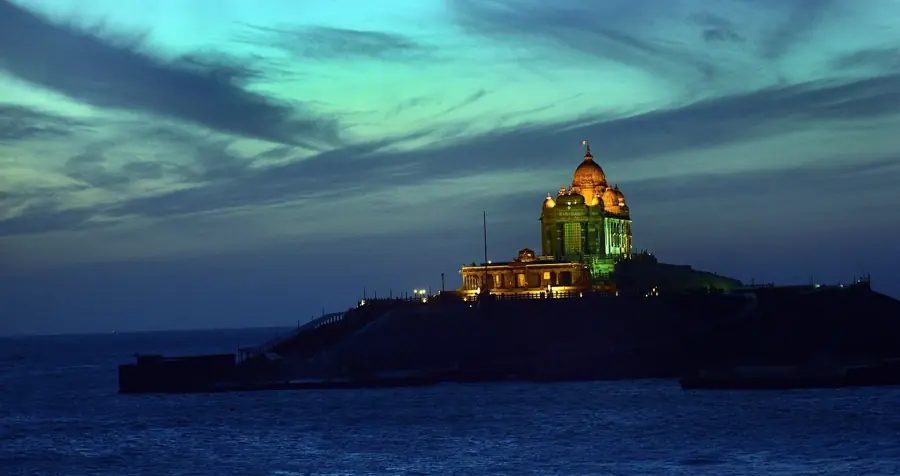
In December 1892 a young monk swam out to this rock and sat on it for three days and nights. He came back with the idea that became the Ramakrishna Mission, and seventy years later the memorial on the rock was built around the spot where he sat. That spot is the Dhyana Mandapam, a dark meditation hall at the back of the complex, and it is the only part of the visit that most people remember afterwards. Everything else — the ferry, the queue, the photographs from the upper terrace — is the frame around it.
The practical shape of a visit is a ferry queue on the shore, a ten-minute crossing, roughly an hour on the rock, and a ferry queue to come back. The government ferry runs from about 8 am to 4 pm and costs around ₹75 return, with a separate memorial entry of about ₹50. In peak season the morning queue at the jetty can run ninety minutes, which is why we push customers onto the 8 am boat and not the 10 am one. Sea conditions close the service outright on rough days, usually in the south-west monsoon, and no amount of planning gets around that. Check before you build a day around it.
What is actually on the rock
Two structures and a view. The Vivekananda Mandapam is the larger hall, built in 1970, with a bronze statue of the monk facing the mainland and a stone floor that gets hot enough by eleven to matter, because shoes come off at the entrance. Behind it is the Shripada Mandapam, built over the rock impression believed to be the goddess Kumari’s footprint, which is the reason the rock was sacred long before 1892. Between them is the Dhyana Mandapam, a low, dark, deliberately silent meditation room with an Om carved on the wall. Sit in it for ten minutes. It is the only place in Kanyakumari where the noise stops. The upper terrace gives you the best view in the district: the mainland shoreline, the temple, the wind turbines on the northern ridge, and the Thiruvalluvar Statue a stone’s throw across the water. Allow an hour on the rock itself. People who plan thirty minutes end up rushing the one part worth slowing down for.
The ferry queue, honestly
This is the single biggest complaint visitors have about Kanyakumari and it is a fair one. The Poompuhar ferry is the only legal way across, the boats hold about a hundred and thirty people, and between mid-December and mid-January the queue at the jetty regularly runs an hour and a half in the sun with limited shade. Tickets are sold at the counter near the jetty and there is no online booking, no fast track and no legitimate agent who can jump you. If someone offers, walk away. What works is arriving at the counter before 8 am and taking the first or second boat, when the whole round trip takes under two hours. By 10:30 the same trip takes three and a half. The second workable option is late — around 2:30 pm — when the morning coach parties have gone and the light is better anyway. Avoid weekends, the first week of January, and any Tamil Nadu school holiday. Our ferry and ticket guide lists the days we tell customers to skip the rock entirely.
Who should not attempt it
We say this plainly because it saves people a bad afternoon. The crossing is short but the boat rocks, boarding is over a moving gangway with a hand from the crew, and there is a flight of steps from the landing up to the memorial with no lift and no ramp. If your parents cannot manage thirty steps and a queue in the sun, this is not the stop for them, and there is no shame in one half of a family going while the other waits at the shore memorials. Life jackets are handed out and the crew are strict about them. Children are fine and usually love it. Wheelchairs cannot be taken across. There are toilets on the rock but they are basic, and no food is sold there, so eat before you board. The strongest word of caution is about timing on a windy afternoon: if the sea gets up, the return ferries slow down and a queue forms on the rock instead of the shore, and you can lose an hour you had planned to spend at the sunset.
Combining it with the glass bridge and the statue
Since 2024 a glass-floored bridge about seventy-seven metres long links the rock to the Thiruvalluvar statue, and it has changed how the visit works. One ferry ticket now gets you onto both rocks, with a separate bridge ticket of around ₹40 bought on the rock itself. In practice this means an hour became two, and the ferry queue got longer because people stay out there longer. Plan for it. The sensible order is: ferry across, memorial first while the stone is still cool, the Glass Bridge next, then the statue base, then the return boat. Doing it the other way round means walking the bridge at midday with the glass throwing heat up at you. If you have half a day rather than a full one, take the ferry and skip the bridge. If you have a full day, this trio plus the Bhagavathy Amman Temple and the shore memorials fills it comfortably and is exactly what our one-day sightseeing tour covers.
Best time of day and year
First boat at 8 am, every time, if you can. The stone is cool underfoot, the meditation hall is empty, the crowd has not arrived and the haze has not built. Second best is the last hour, from about 2:30, when the light turns warm and the return boats are half empty — but keep an eye on the 4 pm cut-off, because being stranded is not a risk we would take lightly. Avoid 10 am to 1 pm in April and May, when the rock is genuinely uncomfortable and bare feet on hot granite become the story of your day. Across the year, October to March is the reliable window. June to September the service is cancelled outright on rough days, sometimes for several days together, and the sea between the shore and the rock turns brown with runoff. If your trip falls in the monsoon, do not build the itinerary around this stop; keep it as a bonus and put Thirparappu Falls in the plan instead, because that is the one time of year the falls are at their best.
Six things our drivers tell every guest
- Be at the ticket counter before 8 am. The first boat turns a three-hour trip into two.
- Carry socks. The granite is painfully hot from about eleven in the morning.
- No food is sold on the rock and the only water is what you carry.
- The Dhyana Mandapam is the point of the visit — give it ten quiet minutes.
- Nobody can fast-track the queue. Anyone who offers is selling you nothing.
- Check the sea condition in June to September; the service is cancelled on rough days.
How to get here
Vivekananda Rock is 500 m offshore from Kanyakumari town, 10 min ferry from the jetty. It is included in our one-day sightseeing package and our five-day pilgrimage package, or we can add it to any local sightseeing day by the hour.
Questions about Vivekananda Rock
Nearby places to add to the same day
 500 m offshore
Thiruvalluvar Statue
The 133 ft Thiruvalluvar Statue stands on its own rock, reached by the same ₹75 ferry. Why the number 133 matters and where to photograph it from.
 500 m offshore
Glass Bridge
A 77-metre glass-floored bridge now links the Vivekananda Rock to the Thiruvalluvar Statue for about ₹40 extra, tripods and food banned on deck.
 In town
Bhagavathy Amman Temple
Kumari Amman Temple opens 4:30 am–12:15 pm and 4–8:15 pm. Men remove upper garments, cameras stay outside, and the nose ring has a sea legend.
Want Vivekananda Rock at the right hour?
We know when the queue is short and when the light is good. One message and it is in your plan.