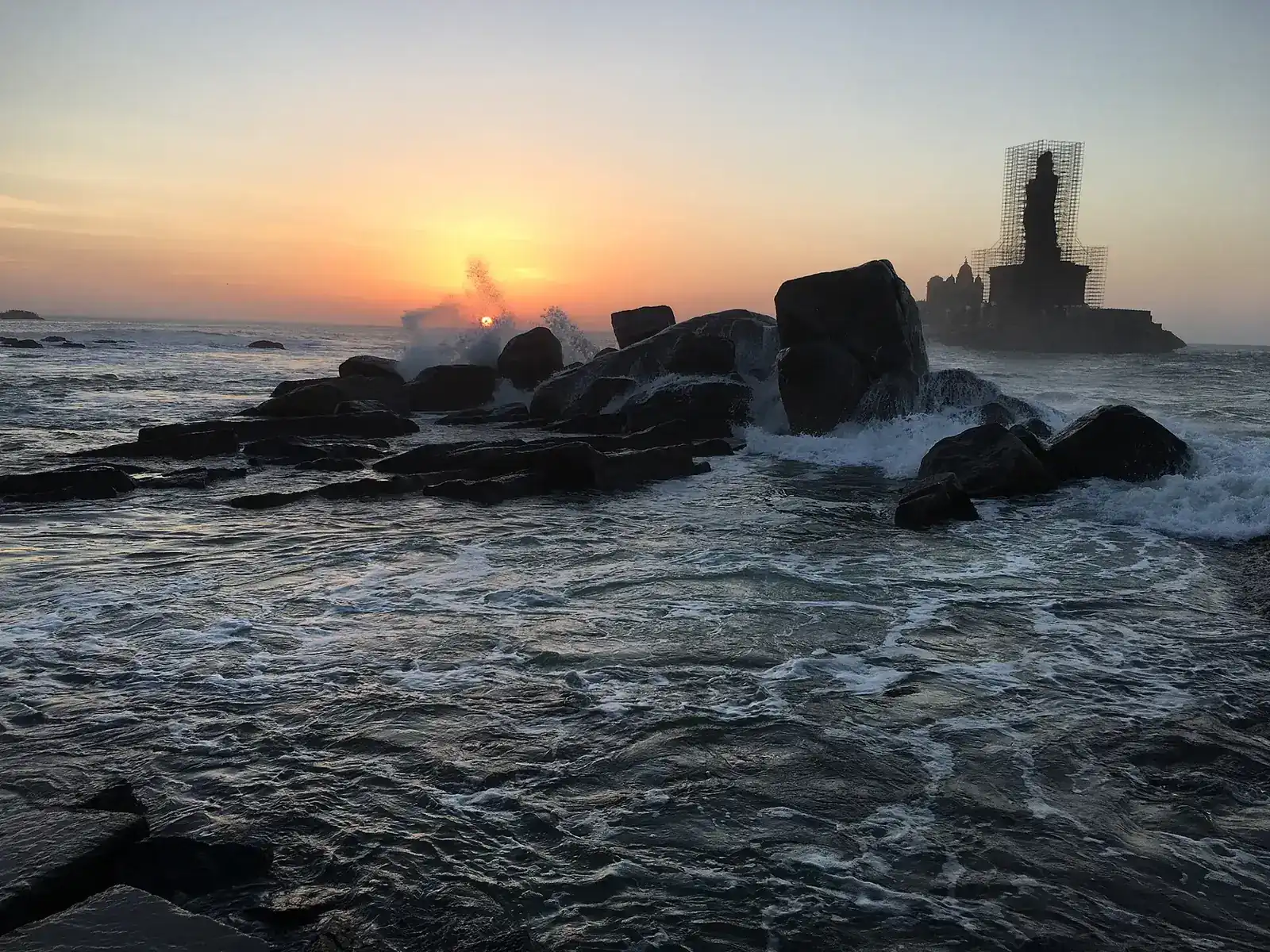
For sunrise, stand on the beach directly below the Gandhi Mandapam, facing the gap between the Vivekananda Rock and the Thiruvalluvar Statue; the sun climbs out of the sea almost exactly between the two in December and January. For sunset, walk 800 metres west to the stretch of shore past the Tsunami memorial, sometimes called the sunset point, where the horizon is open water rather than the harbour. Sunrise is around 6:00 to 6:35 am depending on the month; sunset falls between about 5:55 and 6:40 pm. Full monthly figures are below.
What makes Kanyakumari unusual is not the sunrise or the sunset on its own, both of which you can see from plenty of coastal towns. It is that you can watch the sun rise over the sea and set over the sea from the same small headland on the same day, something almost no other point on the Indian mainland offers, because the land has to curve away sharply on both the east and west sides for that to work. We explain why below, along with the one evening a year when the sunset and the moonrise line up as well.
Cloud cover, not the calendar, decides whether a given morning is worth getting up for, so this guide also gives our own count of clear-sunrise odds by month, drawn from standing on that beach most mornings of the year, not from a general weather forecast.
Exactly where to stand for sunrise
The beach directly in front of the Gandhi Mandapam, on the east side of the headland, is the standard spot, and for good reason: it is flat, it faces open sea, and from late November to February the sun comes up almost in line with the gap between Vivekananda Rock and the Thiruvalluvar Statue, giving the classic silhouette photograph without a telephoto lens. Arrive by 5:45 in winter; the crowd roughly doubles between 6:00 and 6:15 on any weekend.
A quieter alternative fifty metres further along, near the steps by the Kamaraj memorial, gives almost the same view with noticeably fewer people, because most visitors stop at the first open patch of sand they reach and go no further. If you want the statue and the rock framed together with the rising sun behind them, stand here rather than directly in front of the Mandapam, where the crowd bunches.
From June to September the sun rises further to the north, over the fishing harbour rather than between the two rocks, and the beach in front of the temple’s bathing ghat, the Triveni Sangamam, gives a better line. Whichever spot you choose, get there with at least twenty minutes to spare; the light in the ten minutes before actual sunrise is often better than the moment itself, and rushing down after the sky has already coloured means you miss it.
Exactly where to stand for sunset
Walk or drive 800 metres west from the temple to the stretch of shore past the Tsunami memorial, commonly called the sunset point. This side of the headland faces open sea from October to March, when the sun drops straight into the water, and it is the spot every evening photograph you see of a red Kanyakumari sunset was taken from.
There is a second, less crowded option: the rocks just south of the fishing harbour, a five-minute walk further, where you get the same sun but with fishing boats in the frame rather than a beach full of people. Footing is uneven there, so it suits an adult or older child rather than a family with a toddler.
From April to September, the sun does not set into open sea from this side; it drops behind the Kerala coastline to the north-west, so the colour show is shorter and less dramatic, though still worth watching, and the crowd is correspondingly thinner. In these months some visitors get a better sunset by staying at the sunrise-side beach instead, since low evening cloud over the Kerala hills can catch colour that the sunset point itself has already lost to haze.
Either spot fills up by 5:30 in winter; arrive by 5:15 if you want space to set up a tripod without someone stepping into the frame.
Why Kanyakumari is the only mainland point for both
Kanyakumari sits at the southern tip of a headland where the coastline genuinely turns a corner: the Bay of Bengal lies east, the Arabian Sea lies west, and the two meet at a point rather than blending along a straight shoreline. That corner is what makes a sea sunrise and a sea sunset both possible from the same small stretch of land on the same day, because the horizon is open water in both directions rather than land in one of them.
Most of India’s coastline runs roughly north-south, which means a town on the east coast sees the sun rise over the sea and set over the land, and a town on the west coast sees the reverse. Kanyakumari is one of the very few mainland points sharp enough in shape to avoid that trade-off entirely. Cape Comorin, as it was called on old charts, is essentially the last few hundred metres of India before the coastline has nowhere left to go but south into open ocean.
This is also why local guides describe the meeting of “three seas” here, folding in the Indian Ocean to the south alongside the Bay of Bengal and Arabian Sea, a description that is more about tradition and the confluence of currents than a hard oceanographic boundary, but the geography behind the sunrise-and-sunset claim is entirely real and is the reason this headland, alone among mainland points, draws people specifically to watch both.
Month-by-month sunrise and sunset times
These are approximate clock times for Kanyakumari through the year; actual times shift by a few minutes either side depending on the exact date within each month. Use this table alongside the clear-sky odds rather than on its own, since a sunrise at the “right” time behind cloud is worth less than a slightly later one under a clear sky.
| Month | Sunrise | Sunset | Notes |
|---|---|---|---|
| January | 6:35 am | 6:00 pm | Latest sunrise of the year; best clear-sky odds |
| February | 6:28 am | 6:10 pm | Still excellent odds, thinner crowd |
| March | 6:15 am | 6:15 pm | Warming up, odds still good |
| April | 6:00 am | 6:25 pm | Chithra Pournami window (see below) |
| May | 5:55 am | 6:32 pm | Hot, hazy, crowded at the beach |
| June | 5:55 am | 6:38 pm | Monsoon cloud, odds drop sharply |
| July | 5:58 am | 6:40 pm | Latest sunset of the year; lowest sunrise odds |
| August | 6:03 am | 6:30 pm | Cloud easing slightly |
| September | 6:00 am | 6:12 pm | Improving odds as monsoon retreats |
| October | 5:55 am | 5:58 pm | Earliest sunrise of the year |
| November | 6:05 am | 5:55 pm | Earliest sunset of the year; wettest month, but mostly evening rain |
| December | 6:22 am | 5:57 pm | Clearing skies, very high crowds after the 20th |
Notice that the earliest sunrise (October) and latest sunset (July) do not fall in the same months as the best viewing odds. Clear skies matter more than the exact clock time, which is why January and February, not October, are the months we recommend for a guaranteed view.
Chithra Pournami: sunset and moonrise together
On Chithra Pournami, the full-moon day of the Tamil month of Chithirai, falling in April or early May, the sun sets in the west within a few minutes of the full moon rising in the east. Both are visible from the same stretch of beach near the Gandhi Mandapam, sun going down over one shoulder as the moon comes up over the other. This is a genuine astronomical event tied to the full moon closest to this particular point in the calendar, not a marketing description, and it draws real crowds from Tirunelveli, Madurai and further afield, arriving from around 5 pm.
The alignment is sharpest on the exact Chithra Pournami date but is visible, in a milder form, on the full moons in the month either side, so if your travel dates miss it by a few weeks you still get a version of the same effect. Expect the beach and the raised ground near the Kamaraj memorial to be full by 5:30 pm on the main date; arrive by 5 if you want a spot with an unobstructed view of both horizons.
Outside Chithra Pournami, watching the moon rise over the sea on any clear night in the days around a full moon is worth doing even without the sunset lining up, and it is far quieter, since most visitors only turn up for the named event itself.
The monsoon reality: cloud, not rain, is the enemy
Rain rarely falls at 6 am here even in the wettest months, because both the south-west monsoon (June–September) and the north-east monsoon (October–December) tend to bring their heaviest showers in the afternoon and evening. What ruins a Kanyakumari sunrise is a band of low cloud sitting on the horizon 20 to 50 km out, which is common from May through September, and which hides the sun until it has already climbed 15 to 25 degrees above the water, by which point the light is flat and white rather than coloured.
The practical effect: from June to September, expect a clear sunrise on perhaps three mornings in ten. From October to December, despite this being the wettest stretch on the calendar by rainfall volume, sunrise odds recover to six or seven in ten, because the rain itself falls later in the day. January and February remain the safest bet at eight in ten.
Our rule for guests staying more than one night: if the eastern sky is a uniform grey wall at 5:45 am, do not wait it out at the beach. Go for tea on Sannathi Street and try again the next morning rather than the next hour, since a cloud bank sitting that low rarely clears within the same dawn. If you have only one morning and it is cloudy, the ferry and the temple are a better use of first light than standing on a grey beach.
Photography notes: gear, angles and light
A standard zoom, roughly 24-70mm equivalent, covers both spots well; you do not need a long lens for the classic silhouette shot, since the rocks sit close enough to shore that a wide-to-normal frame includes both the Thiruvalluvar Statue and the sun without cropping. A tripod helps most in the ten minutes before actual sunrise, when the light is low but the sky is already coloured, and again for the ten minutes after sunset when the afterglow can outlast the sun itself by a wide margin.
For sunrise, stand slightly south of the main crowd at the Gandhi Mandapam beach to keep the frame clear of heads; for sunset, the rocks past the fishing harbour give a cleaner foreground of boats and nets than the main sunset point, which fills with people from 5:30 in winter.
Salt spray on a lens is a real problem here, more than at most beaches, because the wind off three seas carries fine mist even on a calm morning; wipe the front element just before you shoot rather than relying on a filter alone. Phone cameras handle the silhouette shot better than most compacts, since the dynamic range software copes well with a bright sky and a dark foreground; if you are shooting with a phone, tap to expose for the sky, not the rocks, or the sun will blow out to a white blob with no colour around it.
Crowd patterns by season and time of day
The sunrise crowd builds fast and thins fast. On a December or January weekend the beach below the Gandhi Mandapam is already full by 5:45 am, doubles again by 6:00, and has largely dispersed to breakfast by 6:45. On a weekday in the same months, you can arrive at 6:10 and still find space at the front. In July and August, when the odds of a clear sky are lowest, the crowd is thin even on weekends, since word travels fast when the sky is grey.
Sunset draws a steadier crowd through the evening rather than one sharp peak, building from about 5:15 and staying full until well after the sun has gone, because many visitors linger for the colour in the sky afterwards rather than leaving the moment the sun touches the water. Weekends and the week around Christmas and New Year are the exceptions, when the sunset point is uncomfortably packed by 5:30 and parking on the approach road is difficult after 5.
The single quietest combination on the calendar is a weekday morning in February: clear skies at eight in ten odds, a shrinking pre-exam-season crowd, and comfortable 29 to 31°C weather. If your travel dates are flexible at all, that is the window we would pick over any other for either sunrise or sunset, and it pairs well with the quieter stretch covered in our best time to visit guide.
Written by the Kanyakumari Tours & Travels team in Kanyakumari and re-checked on the ground every month. Spotted something that has changed? Tell us on WhatsApp and we will fix it.