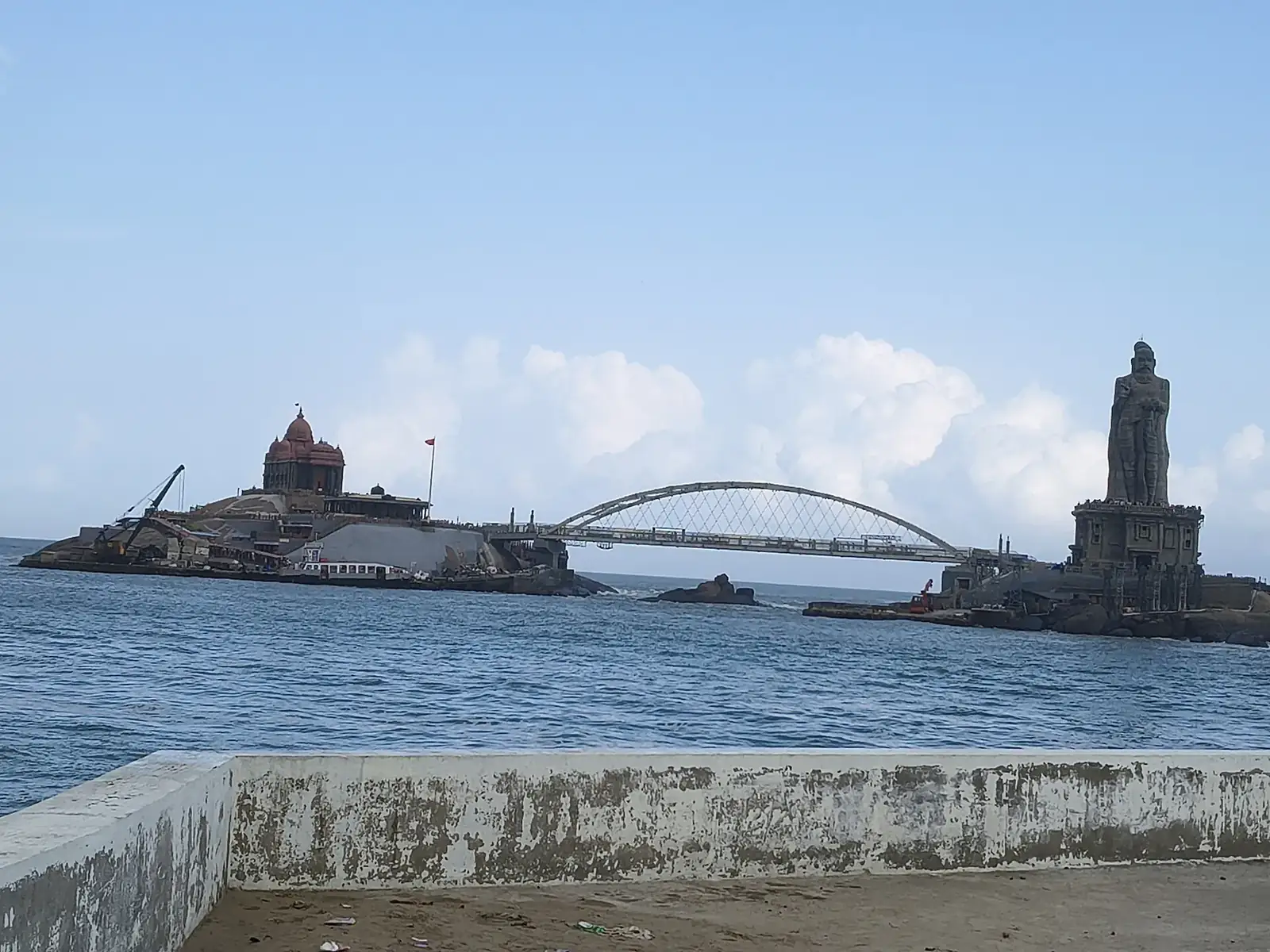
The government ferry to Vivekananda Rock and the Thiruvalluvar Statue sails roughly 8 am to 4 pm, with a return ticket costing about ₹75. The counter sits east of the Bhagavathy Amman temple, a two-minute walk from the seafront. If you also want to cross the glass bridge linking the two rocks, buy that ticket, about ₹40, at the same counter, since there is no separate booth on the rock itself. Queues are shortest right at 8 am and again between 1 and 3 pm; they are longest, sometimes 45 to 90 minutes, between 9 and 11 am when day-trip coaches and independent visitors arrive together.
This is a working ferry service, not a tourist boat, and it is run with the discipline that implies: fixed sailing hours, a genuine capacity limit per crossing, life jackets checked before boarding, and a cloakroom for anything you cannot carry on. It also shuts down completely on days when the sea is too rough, mainly in the June to September monsoon, with no advance notice beyond a board at the counter that morning.
This guide covers where to queue, what the ticket actually gets you, the temple’s separate dress code, and the handful of items you genuinely cannot carry across. We take guests here most days of the year, so the queue-timing advice below is what we see at the counter, not a published schedule.
Where the counter is and how the queue actually moves
The ticket counter is a low building east of the Bhagavathy Amman temple, on the approach road that runs down to the jetty, clearly marked and impossible to miss once you are on the seafront. There is one queue for the ferry, though on busy days staff open a second window for the return-side purchase, which helps only a little since the boats themselves are the actual bottleneck, not the ticket window.
The queue moves in bursts, not steadily. A boat loads, sails, and the queue barely shortens until the next one docks and unloads, roughly every 15 to 20 minutes depending on how many boats are running that day. At 8 am you can be on the first or second sailing with under ten minutes at the counter. By 9:30 on a weekend the queue can run past the Gandhi Mandapam approach, and 45 to 60 minutes is normal. It thins from about 1 pm, when the coach groups have moved on to lunch or Suchindram, and by 2 pm you can often walk straight to the window.
Our drivers time arrivals to these windows deliberately; on the one-day sightseeing package we get guests to the counter by 7:45, ahead of the 8 am opening, specifically to avoid the mid-morning wait.
What the ticket costs and what it includes
The standard return ferry ticket costs about ₹75 per adult, covering the crossing to Vivekananda Rock and back; children under a certain height typically pay a reduced rate, checked at the counter itself since the exact cut-off has shifted over the years. This ticket gets you onto the rock, into the memorial hall, the meditation hall and the Sripada Mandapam with the footprint shrine, all included with no separate entry fee once you are on the rock.
The glass bridge to the Thiruvalluvar Statue rock is a separate ticket, about ₹40, bought at the same counter, not on the rock itself, so decide before you board whether you want to cross. If you only buy the ferry ticket and change your mind once on the rock, you cannot simply pay on the spot; you would need to queue again at the mainland counter, which defeats the purpose.
There is no combined discount ticket as of now, and prices are revised periodically, so treat these as a close guide rather than an exact figure on the day. Cash is the safest bet at the counter; card and UPI acceptance has been inconsistent depending on network signal at the jetty. Keep both ticket stubs until you are back on shore, since they are checked again on return.
Sailing hours, monsoon suspensions and what happens on a cancelled day
The ferry runs approximately 8 am to 4 pm daily, with the last boarding well before 4 to allow the final return crossing. Outside these hours there is no service at all; do not plan to be on the rock for sunset, since you will be on the mainland side by then regardless of season.
From June to September, the sea along this stretch is rough often enough that sailings are suspended for safety on a fair number of days, sometimes for two or three days running during an active monsoon spell. There is no advance public notice; the decision is made each morning by the harbour authorities based on that day’s swell, and it is posted at the counter, not online. If you have travelled specifically to see the rock and the statue, build in a spare day if your trip falls in this window, or check with your hotel or driver the evening before, since local operators usually know by the previous night whether the sea has been unsettled.
On a cancelled day, the Gandhi Mandapam, the Amman temple, the shore itself and the view of both rocks from the mainland remain fully open; you simply cannot cross. This is one of the few genuine reasons an itinerary here needs a buffer day, covered in our monsoon guide.
Temple entry rules and dress code
The Sripada Mandapam on Vivekananda Rock and the Bhagavathy Amman temple on the mainland both enforce a dress code, though the mainland temple is stricter. Men must remove any upper garment, shirt, t-shirt or vest, before entering the Amman temple sanctum; this is checked at the entrance, not optional, and applies regardless of the weather. Women are expected to wear a saree, salwar kameez or comparably modest dress; shorts and sleeveless tops are turned away at both sites.
Cameras and mobile phones are not allowed inside the Bhagavathy Amman temple at all, a rule enforced more strictly than at most South Indian temples; leave phones in the vehicle or the cloakroom rather than expecting to carry them in and simply not use them. On the rock itself, photography is allowed in the open areas but not inside the meditation hall.
Footwear comes off before entering any of these spaces, and there is a shoe-stand near the temple entrance and another near the rock jetty; a small fee applies at both. If you are visiting straight from the beach after sunrise, carry a change of upper garment for men and check that sandals, not just barefoot walking, are practical on the hot stone paths by mid-morning, since the rock’s open courtyard gets uncomfortably hot underfoot after about 10 am in summer.
What you cannot carry, and the cloakroom
Large bags, tripods over a certain size, food and drink in glass containers, and any sharp object are not permitted on the ferry or onto the rock. Water in a plastic bottle is fine. Selfie sticks are generally allowed but discouraged inside the meditation hall. There is no strict list posted in English at every point, so the safest approach is to carry only what you need: phone, wallet, water, sun protection.
A cloakroom near the jetty holds bags and any restricted item for a small fee, and is the practical answer if you are travelling with luggage straight from a train or bus and have nowhere else to leave it before checking into a hotel. It operates through the same hours as the ferry and is not meant for overnight storage.
Umbrellas are allowed but awkward in the boat’s boarding queue and on the rock’s narrow paths; a cap or a folding hat manages sun and light rain better in practice. Wheelchairs are accommodated on the boat with assistance from staff, but the rock itself has steps and uneven stone in places, so anyone with limited mobility should ask at the counter about the easiest route up before buying a ticket, rather than discovering the difficulty once aboard.
The glass bridge: what it adds and whether it is worth the queue
The glass bridge, opened in 2024–25 and roughly 77 metres long, links Vivekananda Rock directly to the Thiruvalluvar Statue rock, replacing the need to take a second short boat hop between them that older guidebooks still describe. The ₹40 ticket is bought at the mainland counter alongside your ferry ticket, and the crossing itself takes five to ten minutes at an unhurried pace, with a see-through floor section over open water partway across.
It is worth the ticket for most visitors; the statue base, at 133 ft one of the tallest in India, is otherwise hard to appreciate from the ferry alone, and the walk across gives a clear view back to the mainland and the meeting point of the three seas. Children under about ten sometimes find the glass floor section unsettling; hold a hand there rather than letting them walk ahead.
The bridge has its own queue at busy times, separate from the ferry queue, and on May and December weekends this can run to 20 minutes or more at the bridge entrance itself, on top of whatever time you spent getting to the rock. If your schedule is tight, the rock alone, without the bridge, is a reasonable thing to cut; see our note on this in the itineraries guide.
Best times to go, by crowd and by light
The single best combination is a weekday between 8 and 8:30 am: the queue is short because the day’s coaches have not yet arrived, and the morning light on the statue and the rock is at its best before the haze builds. The second-best window is 1:30 to 3 pm, when the queue has thinned after lunch, though the light by then is flatter.
Avoid 9:30 to 11:30 am on any Saturday, Sunday or public holiday in the October to March season; this is when pilgrim coaches, day-trip groups and independent travellers all converge, and the queue routinely runs 45 minutes or more. December 20 to January 2 is the single worst stretch of the year, with queues occasionally passing an hour even in the early-morning slot.
If you want to be on the rock for the least crowded experience possible, a weekday in July or August, outside any monsoon suspension, gives you a near-empty crossing and as long as you like in the meditation hall. The trade-off, covered in the monsoon guide, is the real chance of a cancelled sailing that day, so build in a spare morning if this is the plan.
Written by the Kanyakumari Tours & Travels team in Kanyakumari and re-checked on the ground every month. Spotted something that has changed? Tell us on WhatsApp and we will fix it.