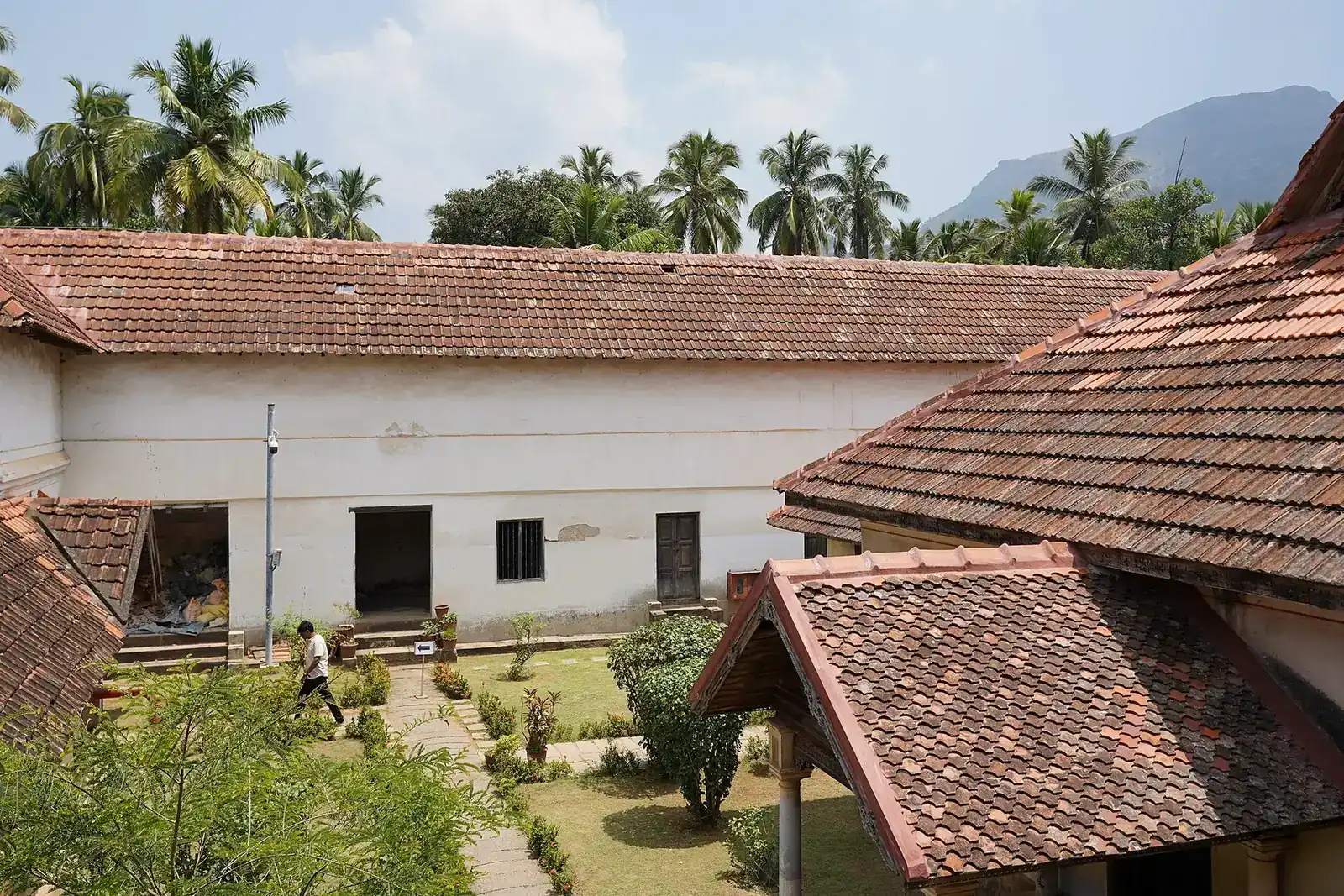
Padmanabhapuram Palace: the wooden palace Kerala runs inside Tamil Nadu
Padmanabhapuram Palace shuts every Monday, and we still meet two or three families a month who have driven the 35 km from Kanyakumari on a Monday morning because a booking site told them it was open daily. That is the single most useful fact on this page. The palace opens at 9 am, the last ticket goes at 4 pm, the gate closes at 4:30 pm, and the Monday closure also applies on Kerala government holidays, which catches people out around Onam and Vishu.
The second oddity is the ownership. The palace stands in Thuckalay, Kanniyakumari district, Tamil Nadu, but it is owned and run by the Kerala government’s archaeology department — a leftover of the 1956 reorganisation, when Travancore’s old capital ended up on the wrong side of the new border. Kerala staff sell the tickets, Kerala signage explains the rooms, and the entry fee is set in Thiruvananthapuram. What you get for ₹35 is the largest wooden palace complex in Asia: about 6,500 square metres of teak, rosewood and jackwood spread over fourteen linked buildings, a clock tower that still works, and the black-mirror floor of the Mantrasala that photographs better than any brochure image of it.
Getting there from Kanyakumari and where to actually park
The route runs Kanyakumari to Nagercoil, then the NH-66 towards Thiruvananthapuram, turning off at Thuckalay. It is 35 km and about 55 minutes when the road is clear, closer to 75 minutes if you leave Kanyakumari between 8:15 and 9:15 on a school morning, because the Nagercoil bypass backs up. Buses from Nagercoil to Thuckalay run every ten minutes and cost about ₹25, then it is a 700 m walk from the Thuckalay stand.
Parking is the part people get wrong. The small lot directly at the palace gate holds perhaps twenty cars and fills by 10:30 on Saturdays and during the April school holidays. There is a larger public ground about 300 m back towards the main road, on the left just before the temple, and walking from there takes four minutes. Our drivers drop at the gate, park at the far ground, and wait there; you call when you come out rather than hunting for the car. If you are travelling with a parent who cannot walk far, tell the driver before you leave Kanyakumari so he times the arrival for the early window. Pair the trip with Thirparappu Falls, 22 km further north, and you have a full, unhurried day.
The Mantrasala, the granite bed and the rooms worth slowing down in
The Mantrasala is the king’s council chamber and the reason most photographers come. Its floor is a polished black composite — the recipe given locally is burnt coconut shell, charcoal, lime, egg white, river sand and plant juices — and it reflects the coloured mica windows above it well enough to look like still water. Shoes come off, no tripod, and the light is best between 10 and 11:30 when the sun reaches the east windows.
Upstairs in the king’s bedchamber is the medicine bed, cut from a single block of granite and said to be a gift from Dutch traders, with a herbal wooden cot beside it. In the Thaikkottaram, the mother’s palace and the oldest part of the complex at roughly 1550, look up: the ceiling has ninety floral medallions, no two the same. The Uppirikka Malika, the four-storey treasury and prayer tower, has the Ramayana murals on its top floor, and access there is sometimes restricted — ask at the counter rather than climbing and being turned back. Also worth two minutes each: the clock tower mechanism, the enormous dining hall built to feed 2,000 pilgrims, and the toilet-and-drainage arrangement, which is quietly more advanced than anything else you will see from that century.
Tickets, cameras and the rules that trip visitors up
Entry is ₹35 for an adult and ₹10 for a child, with ₹300 charged to foreign nationals. A still camera is ₹50, and video is ₹1,500, which is why almost nobody declares one. The counter takes cash; the card machine works about half the time, so carry notes. Tickets stop at 4 pm sharp and the staff mean it — arriving at 4:05 gets you nothing but a look.
Inside, footwear is left at the entrance in a free rack, and it is worth wearing socks because the wooden floors are cold in the mornings and the stone courtyards are hot by noon. Bags larger than a daypack go in the cloakroom. Photography is allowed in most rooms with your ₹50 ticket but banned in the murals room and around some of the palanquins, marked by small boards that are easy to miss. There is no proper cafe inside; a tea stall sits outside the gate and the nearest reliable lunch is in Thuckalay town, five minutes away. Guides wait near the ticket counter and charge ₹300 to ₹500 for a group — the good ones are genuinely worth it because very little inside is labelled in English.
When it is busy, when it is quiet, and the honest downside
Tuesday to Friday between 9 and 11 am is the quiet window. From 11:30 the school groups arrive, and in a narrow wooden corridor a hundred children change the experience completely. Saturdays and Sundays are steady all day. The April and May school holidays are the worst of both worlds here: the crowds are at their peak and the upper floors are genuinely hot, because a wooden building with small windows holds the afternoon heat. Come in December or January and the same rooms are pleasant.
The honest downside is that this is a slow, quiet, look-at-things visit with almost no interpretation. If you are travelling with children under eight, ninety minutes of dark wooden rooms will not hold them, and you are better off fitting the palace around Mathur Aqueduct where they can run. The other complaint we hear is about the one-way route: once you start, you cannot easily double back to a room you liked, so take your photographs when you are standing in front of something rather than planning to return. Our 2 days 1 night package puts the palace on the second morning, which keeps it out of the Monday trap.
Combining the palace with the rest of the western district
The palace sits at the start of the district’s western run, so it makes far more sense as the first stop of a day than as a standalone trip. The standard route we drive is Kanyakumari to Padmanabhapuram by 9, out by 10:45, then 25 km to Thirparappu for late morning, lunch at a Thuckalay or Kulasekharam hotel for about ₹150 a head, then Mathur Aqueduct in the afternoon and back to Kanyakumari by 6. That is roughly 130 km of driving and costs ₹2,800 in a sedan or ₹4,200 in an Innova Crysta, with fuel, tolls, parking and the driver included.
If you are heading onward to Kerala, the palace is a natural first stop of the journey rather than a detour, since the Kaliyakkavilai border is 15 km further on. Travellers coming down from Thiruvananthapuram often do the reverse and reach Kanyakumari by evening for the sunset. One planning note: do not try to add the ferry to Vivekananda Rock on the same day as a palace trip. The ferry queue in season eats two hours and the palace closes at 4:30, so something gets cut, and it is usually the thing you drove furthest for.
Six things our drivers tell every guest
- Never plan this for a Monday. It is also shut on Kerala government holidays, which are not the same as Tamil Nadu ones.
- Reach the gate at 9 am. By 11:30 school groups fill the narrow wooden corridors and the upstairs rooms.
- Carry cash. Entry is ₹35, camera ₹50, and the card machine at the counter is unreliable.
- Wear socks and slip-on shoes. Footwear comes off at the entrance and you will be barefoot on stone and timber for over an hour.
- Take the Mantrasala photographs between 10 and 11:30, when the mica windows throw colour onto the black floor.
- Hire a guide at the counter for ₹300 to ₹500. Almost nothing inside carries an English label.
How to get here
Asia’s largest wooden palace, 35 km up the Thuckalay road. Closed Mondays. is 35 km from Kanyakumari town, 55 min. It is included in our 2 days 1 night package and our 3 days 2 nights package, or we can add it to any local sightseeing day by the hour.
Questions about Asia’s largest wooden palace, 35 km up the Thuckalay road. Closed Mondays.
Nearby places to add to the same day
 55 km
A broad 50 ft curtain on the Kodayar river, 55 km west. Strong June to January, often dry in summer.
Thirparappu Falls is 55 km from Kanyakumari and flows strongly June to January. Entry ₹10, open 8 am to 6 pm. We say which months it runs dry.
 60 km
Mathur Aqueduct
Mathur Aqueduct is 60 km from Kanyakumari, 115 ft high and about 1 km long. Entry ₹10, open 9 am to 6 pm. How to walk the trough and when it is empty.
 12 km
Thanumalayan Temple
Suchindram’s temple has four musical pillars carved from one stone and an 18 ft Hanuman cut from a single granite block, 12 km from Kanyakumari.
Want Asia’s largest wooden palace, 35 km up the Thuckalay road. Closed Mondays. at the right hour?
We know when the queue is short and when the light is good. One message and it is in your plan.