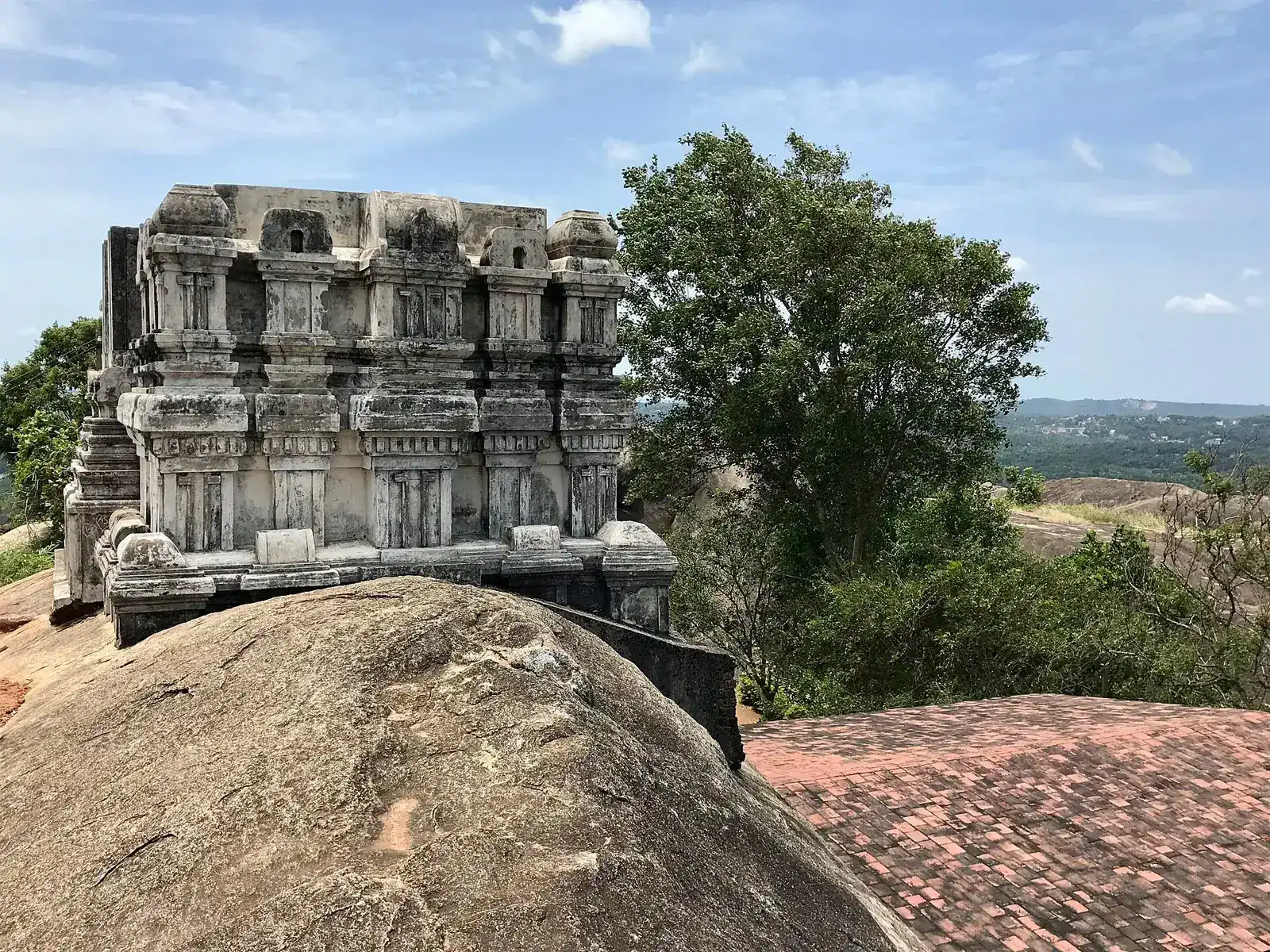
Chitharal: Tirthankaras carved into a hill above Marthandam
Chitharal is the oldest thing you can visit in this district and one of the least visited. On a granite outcrop above Chitharal village, near Marthandam, a natural rock shelter and the faces around it carry a set of rock-cut reliefs of Jain Tirthankaras and yakshis, carved in the ninth century when this was the southern edge of a Jain community that had been here for centuries. The figures of Mahavira and Parshvanatha, and the seated yakshi Padmavathi, are cut in shallow relief into the living rock, and some retain traces of the paint that once covered them. The site is protected by the Archaeological Survey of India and entry is free.
By the twelfth century the shelter had been converted into a Bhagavathy temple, which is why you will find a Hindu shrine standing among Jain carvings, and the local name Chitharal comes from the Tamil for the place of stone dwellings. The practical side is simple: it is 45 km and an hour and ten minutes from Kanyakumari, the climb from the car park takes about ten to fifteen minutes up a steep path and rock-cut steps, the site opens at 9 am and closes at 5, and there is nothing at the top but the rock, the carvings, the little temple and a long view over the coconut country to the Ghats. Go in the morning.
The climb from the village to the rock
The road ends at a small car park below the hill, where there is an ASI board, a ticket-free entrance and a caretaker who will point you up. The path starts as a set of concrete steps between houses and rubber trees, then becomes rock-cut steps and a bare granite slope with an iron handrail on the steepest stretch. It is about 400 metres and ten to fifteen minutes for most people, twenty with stops. This is a short climb but not a flat one, and the last section crosses open rock that is hot from mid-morning and slick when wet.
Footwear with grip matters. The granite is smooth and polished in places from centuries of use, and after rain the caretaker will tell you not to attempt the upper section. There is shade for the first half and none for the second. Carry water; there is nothing at the top and only a couple of small shops in the village below. The handrail is sound but does not run the whole way. Anyone who can manage a flight or two of stairs at their own pace will be fine; anyone with a knee or balance problem should not attempt it, and unlike Marunthuvazh Malai there is nothing to see from the base. The reward at the top is out of proportion to the effort, which is not something we say often.
What is carved on the rock and what to look for
The main group is on the western face of a natural overhang. Look first for the standing Tirthankaras in shallow relief, with the triple parasol and the attendant figures above their shoulders, and then for the seated figures with their emblems. The two most often identified are Mahavira and Parshvanatha, the latter recognisable by the serpent hood behind his head. Alongside them is Padmavathi, the yakshi, seated with a lotus, and there is a group of smaller carvings in the outer faces that are easy to miss because they are weathered and unlabelled.
Inscriptions on the rock are in Vatteluttu and Tamil and record gifts to the establishment, one of them referring to the reign of a Chera ruler, which is how the ninth-century dating is reached. Traces of pigment survive in a few sheltered spots. The structural shrine built later against the rock is the Bhagavathy temple, small and plain, and there is usually no priest present; you may enter, footwear off, and the caretaker will unlock it if he is around. What is striking is how little is signposted. There is an ASI board at the base and almost nothing at the top, so read before you come or you will look at excellent ninth-century sculpture and see interesting shapes. Photography is allowed and there is no camera fee. Do not touch the reliefs; the rock surface is soft in places and the oil from hands does real damage over time.
The view, the light and when to come
The top of the outcrop is a broad granite shoulder and the view from it is the second reason to come. You look south and west over an unbroken sheet of coconut palms, rubber and paddy running to the Kerala border, with Marthandam’s rooftops in the middle distance and the Western Ghats standing up behind. Late in the year, after the rains, the whole plain is a deep green and the air is clear enough to pick out individual ridges. It is a good place to sit for fifteen minutes, and there is usually nobody to share it with.
Light and heat decide the timing. Between 8:30 and 10:30 the sun comes at the western face at an angle that throws the shallow reliefs into relief, which is when they photograph best, and the rock is still cool. By noon the carvings are flat in the light and the granite is too hot to sit on. Late afternoon from about 4 works for the view but the carvings are in shadow. Seasonally, October to February is comfortable; March to May is hot enough that the climb is unpleasant by ten in the morning; June to September is green and fine between showers, but the caretaker closes the upper path when the rock is wet. Weekdays are empty. Even on a Sunday you will meet perhaps twenty people, most of them local.
Getting there and combining it with the western circuit
From Kanyakumari the road runs through Nagercoil and Thuckalay to Marthandam on the NH-66, then a signposted turn inland for about 5 km through rubber to Chitharal village, roughly 45 km in total and an hour and ten minutes. The last stretch is narrow and passes through the village; ask for the malai kovil if the turning is unclear. Parking at the base is ₹20. By bus, take any Thiruvananthapuram service to Marthandam for about ₹40, then a local bus or auto to Chitharal for ₹100 or so.
Chitharal fits well into a western day because it is close to Marthandam and therefore on the road to everything else. The pairing that works best is Chitharal early, at 9 when the gates open and the light is right, then Padmanabhapuram Palace, which is 12 km back towards Nagercoil, then lunch and Thirparappu Falls or Mathur Aqueduct in the afternoon. That is a full 150 km day at ₹2,800 in a sedan or ₹4,200 in an Innova Crysta, everything but tickets and meals included. Travellers on their way into Kerala can take Chitharal in without any detour at all, since the Kaliyakkavilai border is 20 km on. Marthandam has proper hotels for lunch at about ₹150 a head; Chitharal village has tea and biscuits.
Who should come, and the honest limits
Chitharal rewards people who like old things and do not need them packaged. If you have any interest in South Indian sculpture, in Jainism, or in the layers of religious history in this part of the country, this is the most interesting hour in the district and it costs nothing. Photographers get shallow relief in raking morning light with no crowds. Anyone who has done the coast and the temple circuit and wants something genuinely different will find it here.
The limits are plain. There is no interpretation, no guide, no museum and no facilities beyond a toilet at the base that is best avoided. Children will see some carvings on a rock and be bored in ten minutes unless they enjoy the climb. Anyone unsteady on their feet cannot get up. The site is small: the carvings occupy a few square metres of rock face and you will have seen everything in twenty-five minutes, which means this is a stop rather than a destination and only makes sense on a day that includes two or three other places. And it is not a place for a single-day visitor to Kanyakumari; there is simply too much else. Come on the second or third day, on a western circuit, early in the morning, having read a paragraph about Tirthankaras first. Do that and you will remember Chitharal after you have forgotten several bigger places on the list.
Six things our drivers tell every guest
- Come between 8:30 and 10:30 am. The morning sun rakes across the reliefs and the granite is still cool underfoot.
- Read a paragraph about Jain Tirthankaras before you arrive. There is almost no signage at the top.
- Wear shoes with grip. The upper section is polished bare granite and the caretaker closes it when wet.
- Do not touch the carvings. The rock is soft in places and hands do slow, permanent damage.
- Carry water. There is nothing at the top and only tea shops in the village below.
- Treat it as a 45-minute stop on a western circuit day, not as a destination in itself.
How to get here
Chitharal Jain Rock is 45 km from Kanyakumari town, 1 hr 10 min. It is included in our 3 days 2 nights package and our kerala + kanyakumari package, or we can add it to any local sightseeing day by the hour.
Questions about Chitharal Jain Rock
Nearby places to add to the same day
 35 km
35 kmAsia’s largest wooden palace, 35 km up the Thuckalay road. Closed Mondays.
Padmanabhapuram Palace is 35 km from Kanyakumari, open 9 am to 4.30 pm, closed Mondays. Entry ₹35, camera ₹50. The Mantrasala and granite bed explained.
 55 km
55 kmA broad 50 ft curtain on the Kodayar river, 55 km west. Strong June to January, often dry in summer.
Thirparappu Falls is 55 km from Kanyakumari and flows strongly June to January. Entry ₹10, open 8 am to 6 pm. We say which months it runs dry.
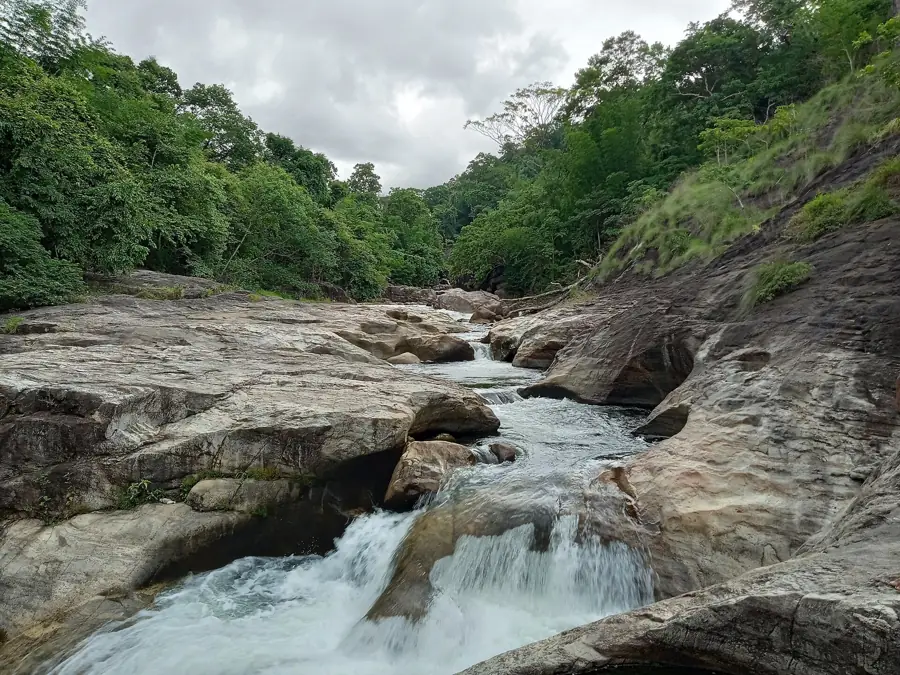 45 km
45 kmKalikesam
Kalikesam is 45 km from Kanyakumari, a shallow forest stream with a temple and bathing pools. Entry ₹10, open 8 am to 5.30 pm. Mind the monkeys.
Want Chitharal Jain Rock at the right hour?
We know when the queue is short and when the light is good. One message and it is in your plan.