Kalikesam: a forest stream where local families spend Sunday
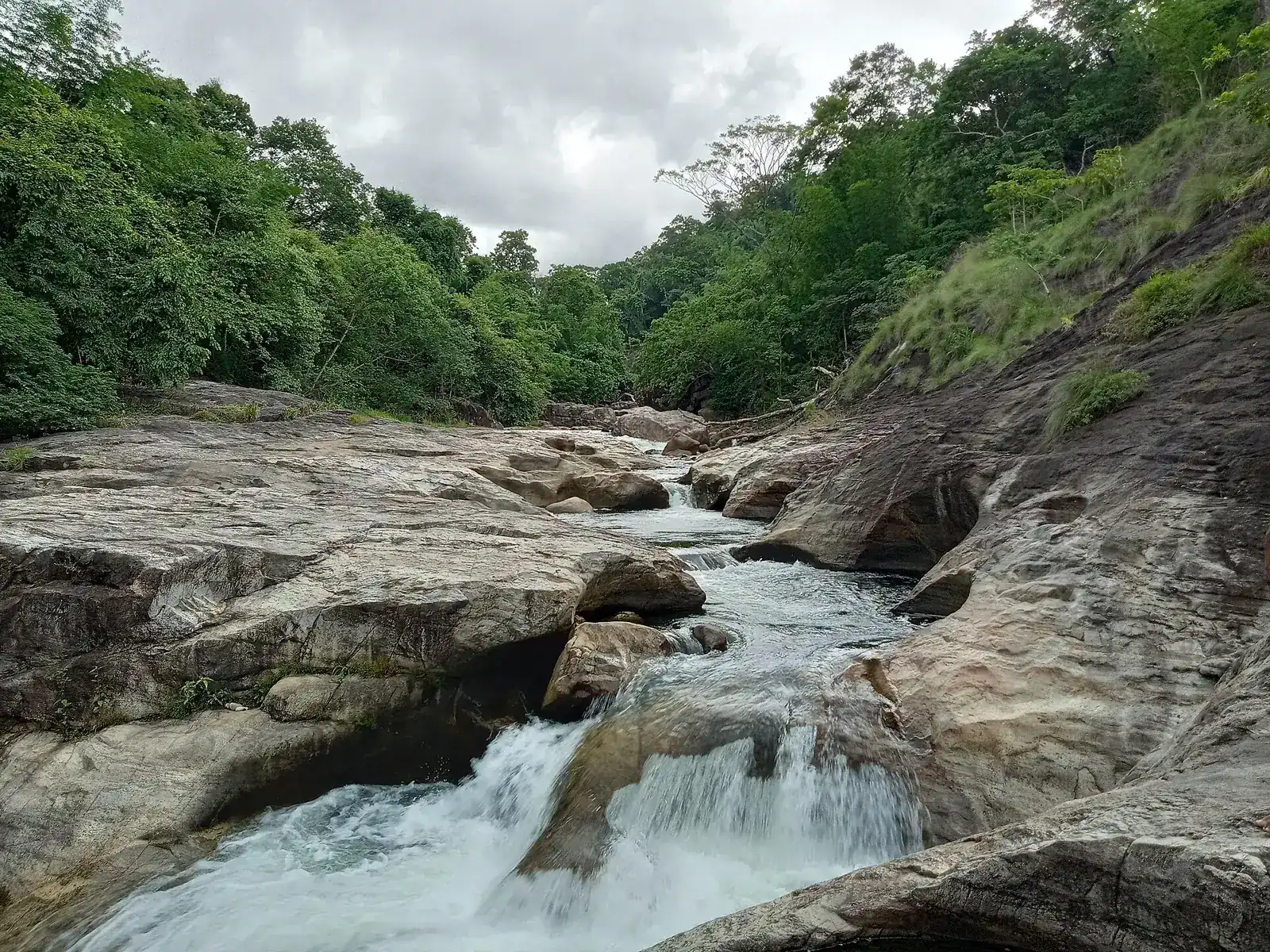
Kalikesam is not a waterfall and does not pretend to be one. It is a place where a hill stream comes out of the reserve forest above Kulasekharam and runs over broad rock slabs and into a series of shallow pools, with tall trees closing in on both banks and a small Kali temple on the rise above the water. Local families have picnicked here for generations. Tour buses do not come, there is nothing to photograph that will impress anyone at home, and that is precisely the appeal: on a weekday morning in November, this is forty-five kilometres of driving to sit with your feet in cold water and hear nothing but the stream.
The site is 45 km from Kanyakumari, a little over an hour, on the road that runs north from Kulasekharam towards the Kerala border. Entry is ₹10, the gate opens at 8 am and clears at 5:30, and there is a changing room, a toilet block and a couple of tea stalls. The stream runs well from August to January and thins sharply from March. The one thing everybody remembers about Kalikesam is the monkeys, which are numerous, bold and organised, and which will take an unattended bag apart within a minute. Keep that in mind and it is one of the pleasanter half days in the district.
The stream, the pools and where people sit
From the gate a path drops through trees to the water in about three minutes. The stream arrives from the forest through a narrow rocky channel, spreads over a wide slab where it is only ankle deep, then gathers into two or three pools, the largest of which is chest deep on an adult when the flow is good. The slab is where children play and where most families put down their mats, because the water there is warm by midday and there is nowhere to get out of your depth. The deeper pool below has a rope across it in season and is where local men swim.
Upstream of the slab, a path follows the bank for perhaps two hundred metres to where the forest properly closes in and the stream runs through a small gorge. Few visitors bother, and it is the best part of the site: cool, dark, loud with water, and usually empty. Do not go further than the marked end of the path, which is the reserve forest boundary. Downstream the stream runs out of the site through rubber holdings and there is nothing to see. The banks are rock and coarse sand with shade from mid-morning on the western side, which is where to sit if you are staying for a few hours. There are stone benches near the temple and a patch of open ground used for cricket that turns into a car overflow on Sundays.
The monkeys, and how to not lose your lunch
The bonnet macaques at Kalikesam are the most confident we know of in the district. They are habituated, they work the picnic area in a troop, and they understand plastic bags. A bag left on a rock while you are in the water will be opened. A packet held loosely in one hand will be taken from that hand, sometimes with a scratch. They are not aggressive in the way that word is usually used, but they are not shy either, and they know exactly which of you is nervous.
The rules that work: keep everything in a closed rucksack with the zips fully shut, not a carrier bag. Put the rucksack against a rock with someone sitting on the same rock, not alone under a tree. Do not eat standing up in the open. Do not feed them, however much your children want to, because a fed troop moves from opportunistic to insistent, and the family after you pays for it. Do not carry an open water bottle in your hand near the temple steps. If one takes something, let it go; chasing gets you nowhere and people have been bitten doing it. Spectacles and phones are stolen for the novelty and abandoned twenty metres away. None of this is a reason to stay away, and locals manage it without a thought, but the number of visitors who arrive with a loose bag of bananas and leave without it is high enough to be worth the paragraph.
The temple and the character of the place
The Kali temple sits on a rise above the stream, reached by a short flight of stone steps. It is small, old and plainly built, with a black stone image and a priest who is present at puja times rather than all day. This is a village shrine rather than a monument, and the etiquette is the usual one: footwear off at the steps, quiet, no photography inside. The site takes its name from the temple and on festival days, particularly in the Tamil month of Aadi, the place fills with local worshippers and the picnic area becomes secondary; if you arrive on one of those days the atmosphere is good but the quiet is gone.
What gives Kalikesam its character is what it lacks. There is no laid-out garden, no boating, no concrete animals, no ticketed viewpoint. The forest department and the panchayat keep it tidy and no more. That makes it the closest thing in the district to a plain, ordinary place where people go to be beside water, and it is why local families choose it over Thirparappu when they want somewhere calmer. Tea stalls near the gate sell tea, vadai and biscuits from about 9 am; there is no meal to be had, so eat in Kulasekharam or bring food. Toilets and a ₹10 changing room are by the car park and are adequate rather than good.
Water, seasons and safety in the stream
The stream is rain-fed from the hills, not released from a dam, so it follows the monsoons directly. From June it starts to run, August to January it is dependable and the pools are full, and February is still fine. From March to May it narrows to a shallow run over the slabs; children can still paddle, the shade is still there, and it is honestly still a pleasant morning, but the deeper pool disappears and anyone hoping to swim will be disappointed. Ask at the gate, where the staff will tell you the truth about the level.
Safety is straightforward with one exception. The slab and the shallow pools are safe, the water is clear, and the bottom is rock and sand. The exception is spate: after heavy rain in the catchment above, the stream can rise quickly even when it is not raining where you are standing, and the water turns brown and pushy. Staff clear the water on those days and rope it off. Take that seriously; the channel above the slab is narrow and the flow through it is stronger than it looks. Rocks throughout are slippery with algae in the wet months, and most of the minor injuries here are simple falls. Wear something with grip rather than going barefoot across the slab, keep small children within reach, and do not climb the rocks in the upper channel to pose for a photograph.
Getting there and fitting it into a day
From Kanyakumari the drive is Nagercoil, Thuckalay, Kulasekharam, then about 8 km north on the Kerala border road, roughly 45 km and an hour and ten minutes. The last stretch is a narrow tarred road through rubber, and the turning to Kalikesam is signposted but small. Parking is a shaded lot near the gate at ₹30 for a car; on Sunday afternoons it fills and cars line the approach. By bus, take a Nagercoil to Kulasekharam service for about ₹35 and then a local bus or share auto for the last 8 km; the last convenient bus back from Kulasekharam is around 7 pm.
Kalikesam works best as half of a day rather than the whole of one. The pairing we use most is Kalikesam in the morning, when it is quiet and the light in the upper channel is good, lunch in Kulasekharam for about ₹130 a head, then Thirparappu Falls or Mathur Aqueduct in the afternoon. Families who want a full day in water do Kalikesam and Thirparappu together and nothing else, which is a relaxed 120 km round trip at ₹2,800 in a sedan or ₹4,200 in an Innova Crysta, driver and parking included. If you are heading into Kerala at Kaliyakkavilai, Kalikesam is barely off the route.
Six things our drivers tell every guest
- Everything goes in a zipped rucksack. The monkeys here open carrier bags and take packets out of hands.
- Never feed them. A fed troop becomes insistent and the next family pays for it.
- Walk the two hundred metres upstream to where the forest closes in. It is the best part and almost nobody goes.
- August to January for full pools. March to May the stream is ankle deep over the slabs.
- Eat in Kulasekharam or bring food. The stalls at the gate sell only tea and snacks.
- Wear footwear with grip on the slab. The algae in the wet months causes more injuries here than the water does.
How to get here
Kalikesam is 45 km from Kanyakumari town, 1 hr 10 min. It is included in our family tour package and our 3 days 2 nights package, or we can add it to any local sightseeing day by the hour.
Questions about Kalikesam
Nearby places to add to the same day
 55 km
55 kmA broad 50 ft curtain on the Kodayar river, 55 km west. Strong June to January, often dry in summer.
Thirparappu Falls is 55 km from Kanyakumari and flows strongly June to January. Entry ₹10, open 8 am to 6 pm. We say which months it runs dry.
 60 km
60 kmMathur Aqueduct
Mathur Aqueduct is 60 km from Kanyakumari, 115 ft high and about 1 km long. Entry ₹10, open 9 am to 6 pm. How to walk the trough and when it is empty.
 45 km
45 kmChitharal Jain Rock
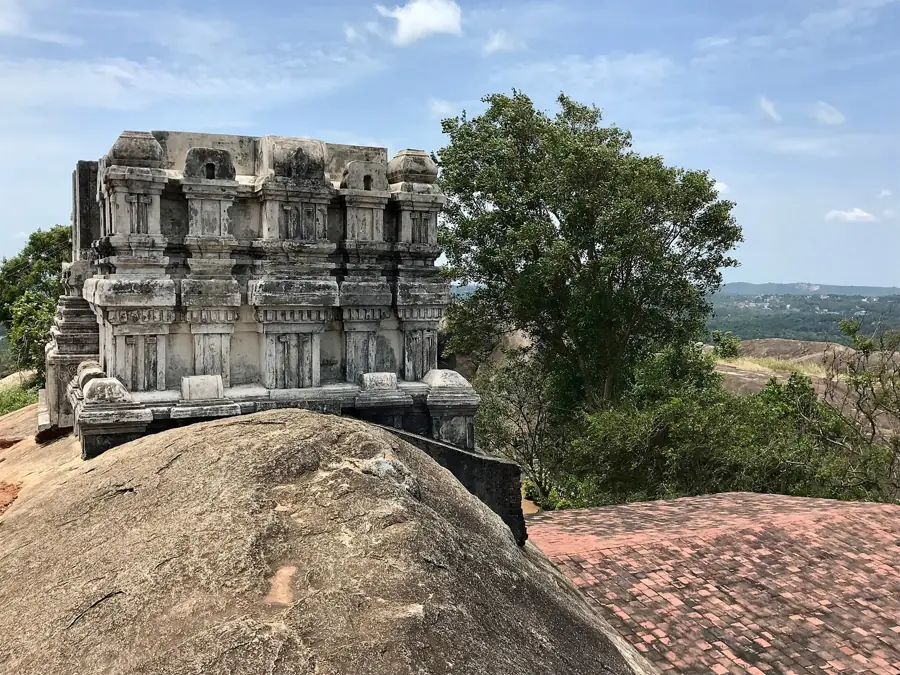
Chitharal, 45 km from Kanyakumari near Marthandam, holds 9th-century rock-cut Jain reliefs. Free ASI site, a steep short climb, open 9 am to 5 pm daily.
Want Kalikesam at the right hour?
We know when the queue is short and when the light is good. One message and it is in your plan.