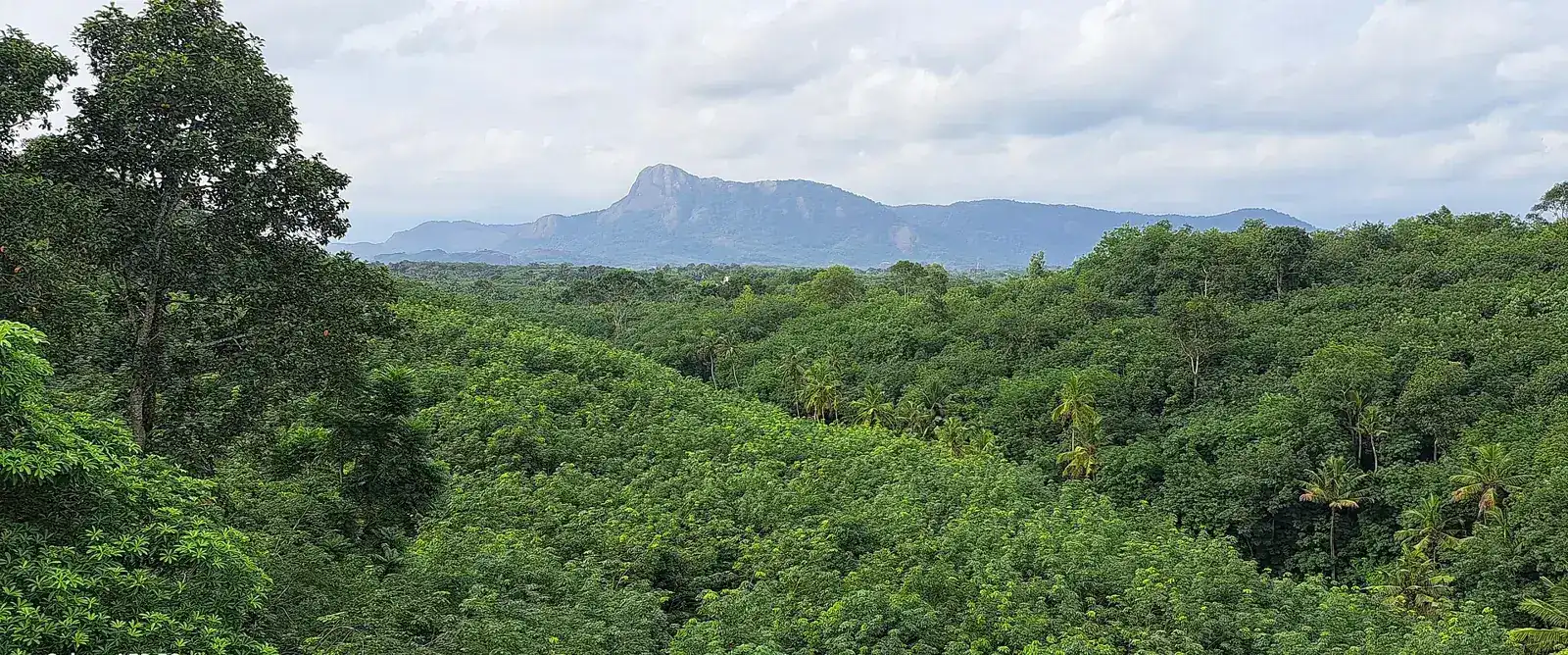
Marunthuvazh Malai: the medicine hill on the edge of town
Marunthuvazh Malai is the small green hill you see on the right as you drive into Kanyakumari from Nagercoil, and it is the easiest genuine climb in the district: twenty to thirty minutes up a stepped and rocky path from the car park to a flat top with a view over the coconut belt to the sea. The name means the hill where medicine lives. Local belief holds that this is a fragment of the Sanjeevani mountain that Hanuman carried from the Himalayas for Lakshmana, dropped here on the flight south, which is why the slope is said to grow herbs found nowhere else in Tamil Nadu. Siddha practitioners have collected on this hill for centuries and still do.
At the base is an ashram and a Siddha clinic, quiet and open to visitors, with a small shrine and a hall where people sit. Entry to everything is free; parking is ₹20. The climb is short but it is a real climb, over loose rock in places, with no shade at all on the upper half, which is why the only sensible times are early morning and late afternoon. It is 7 km from town, fifteen minutes by car, and the whole visit including the walk takes an hour and a half. For anyone staying two nights in Kanyakumari who wants an hour outdoors that is not a beach or a temple queue, this is the obvious answer.
The climb: path, time and what it is like underfoot
The path starts behind the ashram, where a set of concrete steps runs up the first third of the slope. Those steps are easy. Above them the route becomes a worn track over bare rock and loose stones, marked by paint dots and by the polish of many feet, steepening in two short sections where most people use their hands. It is not exposed and there is no drop beside the path, but the surface is the kind that turns an ankle if you come down it quickly in the wrong shoes. Trainers or anything with grip; not sandals, and certainly not the flip-flops half the visitors arrive in.
A reasonably fit adult takes twenty minutes to the top, twenty-five to thirty at a family pace, and fifteen to come down carefully. Children from about six manage it happily. The upper half has no shade whatsoever and the rock radiates heat from mid-morning, which is the single reason people find this climb unpleasant: at 1 pm in April it is genuinely punishing, and at 7 am in December it is a pleasant walk. Carry water; there is a stall at the base but nothing above it. At the top the ground flattens into a rocky shelf with scrub, a small shrine, and a few boulders people sit on. There is no railing and no shelter, so in a thunderstorm the top is the wrong place to be, and local people come down quickly when the cloud builds over the ghats.
The view from the top and the best light
The view is the reward and it is a genuinely good one. To the south and east the coconut belt runs flat to the coast and you can pick out Kanyakumari town, the twin rocks with Vivekananda Rock Memorial and the Thiruvalluvar Statue offshore, and on a clear day the white line of surf along the Muttom coast to the west. Inland and north the Western Ghats rise in a blue wall, with the wind turbines of Muppandal turning across the gap. It is the only place near town where you can see the geography of the district in one turn of the head, and it explains the wind, the rain and the roads better than any map.
For light, early morning is cleanest: the air is still, the haze has not built, and the sun comes up over the sea to your left, so you can watch the sunrise from here instead of from the crowded deck in town, which a handful of visitors do every day. Late afternoon from 4:30 gives warm light on the ghats and a sunset that drops behind the hills rather than into the sea. Between October and February the visibility is best. From June to September the ghats are often in cloud and you may see only the near coast. Midday in any month is hazy and hot and shows the view at its worst.
The ashram, the Siddha tradition and the herbs
At the foot of the hill is an ashram associated with the Siddha tradition, with a small shrine, a hall for sitting and a dispensary. Visitors are welcome, and the expectation is simply quiet: footwear off, phones down, no photography inside the hall. Nobody will ask you for money, and there is no ticket. Some mornings there is a free meal served to whoever is present. It is worth twenty minutes before or after the climb, and it is the part of the visit that tells you what the hill actually means to people here.
The herbs are the reason for the name. Siddha medicine has drawn plants from this hillside for a very long time, and practitioners still collect here, which is why you may see someone working the slope with a cloth bag early in the morning. Do not pick anything yourself; besides being pointless without knowing what you are looking at, the collection is taken seriously by the people who depend on it. The Sanjeevani story is told confidently by everybody you will meet and it is part of the place. What you will actually see on the slope is ordinary-looking scrub, not a botanical garden, so come for the climb, the view and the atmosphere and treat the herbs as context rather than a sight. A short paved walk near the base is lined with named medicinal plants for anyone who wants the labelled version.
Getting there, parking and timing your visit
Marunthuvazh Malai is at Maruthuvazhmalai village, about 7 km from Kanyakumari on the Nagercoil road, then a short turn towards the hill. It is fifteen minutes by car. Any Nagercoil bus from Kanyakumari will drop you at the junction on the highway for about ₹12, and it is a ten-minute walk from there. An auto from Kanyakumari costs ₹200 to ₹250 one way and will usually wait for ₹400 return. Parking at the base is ₹20 and the lot is small but rarely full, except on weekend evenings.
The best plan for most visitors is to fold it into a morning. Our drivers often take guests here at 6:30, before the heat, and then on to Vattakottai Fort or back to town for breakfast; the whole thing is done by 9. The alternative is 4:30 pm followed by sunset at the coast. It is 7 km, so it costs almost nothing to add: within the local day rate of ₹2,800 in a sedan or ₹4,200 in an Innova Crysta it is effectively free, and even as a standalone auto trip it is under ₹500. Do not schedule it between 11 and 3. Every complaint we have ever heard about this place comes from someone who climbed it at noon in May.
Who it suits, and the honest downsides
This suits anyone who wants twenty minutes of effort and a good view without a long drive. Families with children over six do well; the children usually run up and wait at the top. Early risers who are tired of the sunrise crowd in town get their sunrise here with about four other people. Anyone interested in Siddha medicine or in local religious tradition gets something the guidebooks do not cover. And it is free, which after a week of tickets and ferry queues is its own pleasure.
The downsides are real. The path is loose rock and there is no handrail above the concrete steps, so it is not suitable for anyone unsteady on their feet or with a knee problem; there is no gentler route to the top. There is no shade, no shelter, no toilet above the base and no water for sale on the hill. The top is small and on a weekend evening it can hold thirty people, which is enough to feel crowded. Litter is a problem on the upper path despite the bins at the base, and you may find plastic in the scrub. And if you are in Kanyakumari for a single day, this does not make the itinerary; the ferry, the temple and sunset will fill it. It is a second-day or third-day place, which is exactly how our 2 days 1 night package uses it.
Six things our drivers tell every guest
- Climb before 8:30 am or after 4:30 pm. The upper half has no shade at all and the rock holds the heat.
- Wear shoes with grip. Above the concrete steps the path is loose stone and worn rock, and people turn ankles coming down.
- Carry your own water. There is a stall at the base and nothing on the hill.
- Watch the sunrise from the top instead of the town deck if you want the same sun with four people instead of four hundred.
- Spend twenty minutes at the ashram. Footwear off, phones down, no ticket and nobody will ask you for anything.
- Come down when cloud builds over the ghats. The top is bare rock with no shelter.
How to get here
Marunthuvazh Malai is 7 km from Kanyakumari town, 15 min. It is included in our 2 days 1 night package and our one-day sightseeing package, or we can add it to any local sightseeing day by the hour.
Questions about Marunthuvazh Malai
Nearby places to add to the same day
 7 km
7 kmVattakottai Fort
An 18th-century granite sea fort 7 km from Kanyakumari, built under Marthanda Varma’s Dutch commander De Lannoy, ASI-protected, best seen late afternoon.
 In town
Sunset Point
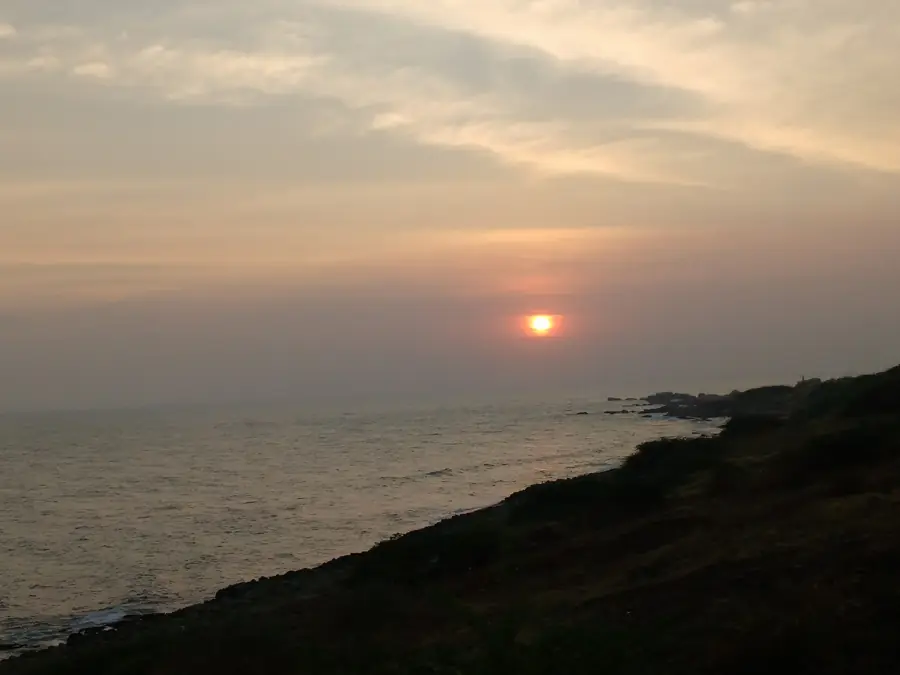
Kanyakumari is the only mainland point to watch sunrise and sunset over the sea from nearly one spot. Sunset Point is free — best 30 minutes before dusk.
 12 km
12 kmThanumalayan Temple
Suchindram’s temple has four musical pillars carved from one stone and an 18 ft Hanuman cut from a single granite block, 12 km from Kanyakumari.
Want Marunthuvazh Malai at the right hour?
We know when the queue is short and when the light is good. One message and it is in your plan.