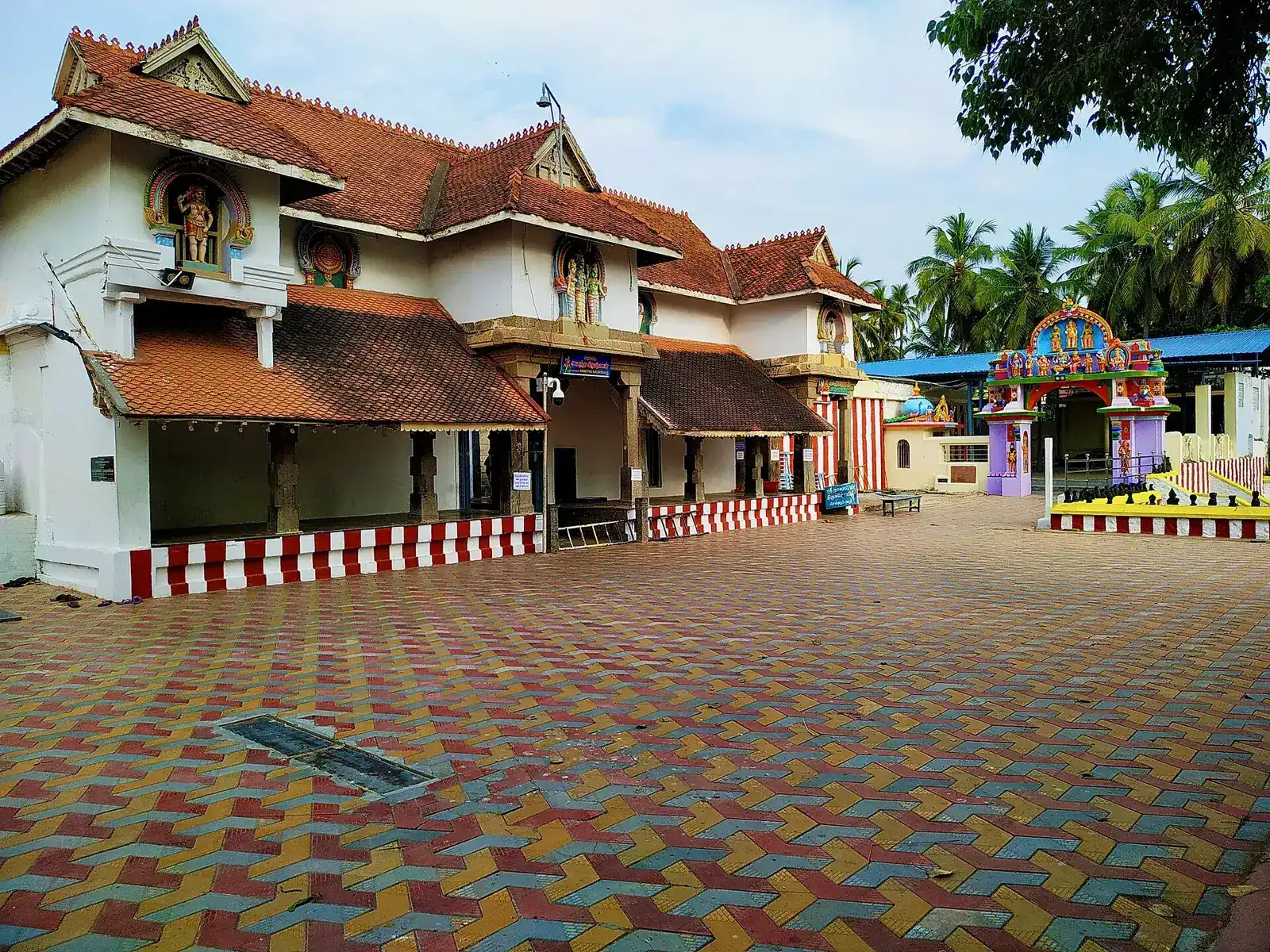
The serpent temple that named an entire city
Nagercoil, the district headquarters and rail junction twenty kilometres from Kanyakumari, takes its name directly from this temple — Nagaraja Kovil, the temple of the serpent king, with Nagercoil literally meaning the town of the snake temple. The deity worshipped here is Nagaraja, a serpent god, and the temple’s most distinctive physical feature is its sanctum floor, which is sand rather than stone, said never to run out however much is removed by devotees over the years, a detail every local guide mentions early in any visit.
Architecturally this is one of the more unusual temples in the district, with carving and structural details that show clear influence from Jain and Buddhist traditions alongside the more typical Dravidian temple style, a mix that reflects the layered religious history of this part of Tamil Nadu before its current form settled. It is a working temple in a busy town rather than an isolated monument, so the approach is through ordinary Nagercoil streets rather than a dedicated scenic road. Morning, before the midday closure common to temples across this district, is the practical window for an unhurried visit, and forty-five minutes covers the complex comfortably for most visitors.
The sand floor and its story
The sanctum area’s floor is sand rather than the stone or tile found in most South Indian temples, and local tradition holds that the sand replenishes itself however much is taken away by devotees, a belief repeated by guides and temple staff alike as one of the temple’s defining features. Whatever the literal truth of the replenishment claim, the floor is a genuinely distinctive physical detail that sets this temple apart from every other stop in the district, and it is one of the first things worth looking for on arrival rather than something easily noticed by accident. Visitors sometimes take a small amount of the sand as a keepsake, a practice temple staff generally tolerate within reason. The texture underfoot is also simply different from anywhere else on a typical Kanyakumari-district circuit, and combined with bare feet, required as at every temple here, it makes for a physically distinctive experience rather than merely a visual one.
Jain and Buddhist echoes in the architecture
Look closely at the carving styles and structural details around the complex and you find influences that do not match the purely Dravidian temple architecture found elsewhere in the district, with elements that art historians trace to Jain and Buddhist traditions that had a real presence in this region before Hindu temple architecture came to dominate it so completely. This layered history is not something the temple foregrounds with signage or a guided explanation, so it helps to know in advance what to look for rather than expect an on-site display to point it out. It is a useful reminder that the religious landscape of Tamil Nadu’s deep south was considerably more mixed centuries ago than the temple-dominated present suggests, and Nagaraja Temple is one of the clearer physical traces of that mixed history still standing and in active use as a place of worship today rather than preserved only as a ruin or a museum piece.
Why the temple gave Nagercoil its name
Nagercoil is the district headquarters, the main rail junction for the region, and the town most visitors pass through on the way between Kanyakumari and Trivandrum, yet relatively few visitors realise the town’s name comes directly from this temple rather than the other way round. Nagaraja Kovil predates the town’s development as a transport and administrative hub by a considerable margin, and the settlement grew up around the temple rather than the temple being added to an existing town. This piece of context changes how the temple reads: not a stop added to an itinerary passing through a railway town, but the actual origin point of the town itself, with the modern station and bus stand having grown up around a much older religious site. Knowing this before arriving gives the visit a different weight than treating it as simply one more temple on a list of regional stops to tick off.
Visiting hours and the midday gap
The temple follows the same pattern as most major temples in the district, open in the morning until around noon and reopening in the early evening, with a closure through the middle of the day. Morning is the more practical window for visitors combining this stop with other places on a day trip out of Kanyakumari, since arriving in the early evening slot means fitting the visit around whatever else is already scheduled for that time of day. The town itself is busy and commercial around the temple, quite different from the quieter approach to Suchindram or the coastal setting of Vattakottai Fort, so allow a little extra time for navigating traffic and finding parking near the complex, which is tighter here than at almost any other stop on the near circuit given Nagercoil’s role as the district’s main town and its constant flow of buses, autos and shoppers around the temple streets.
Combining it with the wider circuit
Nagercoil sits on the route between Kanyakumari and both Suchindram and Padmanabhapuram Palace, making the Nagaraja Temple an easy addition to a longer day rather than a destination requiring a separate trip. Because it is a working town temple rather than a standalone monument, it also makes sense to combine the visit with anything else you need from Nagercoil itself, whether that is the railway station, a larger selection of shops than Kanyakumari town offers, or simply a proper lunch at one of the town’s better-known restaurants before continuing the circuit. Our temple-focused itineraries route through here specifically because it completes a trio with Suchindram and the Amman temple in Kanyakumari, giving a genuine sense of the district’s temple architecture across three quite different sites in a single day without excessive driving between them or wasted time sitting in traffic on the road between one stop and the next.
Six things our drivers tell every guest
- Visit in the morning before the roughly noon closure; the evening slot means fitting around other plans.
- Look for the sand floor in the sanctum area — a genuinely distinctive feature worth seeking out on arrival.
- The Jain and Buddhist architectural influences are not signposted; know what to look for before you go.
- Parking near the temple is tighter than at other stops, since it sits in Nagercoil’s busy town centre.
- Combine the visit with anything else you need from Nagercoil, since it is a working town rather than an isolated site.
- Pair it with Suchindram and the Amman temple for a single day covering three distinct temple architectures.
How to get here
Nagaraja Temple is 20 km from Kanyakumari town, 35 min by road. It is included in our one-day sightseeing package and our temple circuit package, or we can add it to any local sightseeing day by the hour.
Questions about Nagaraja Temple
Nearby places to add to the same day
 12 km
12 kmThanumalayan Temple
Suchindram’s temple has four musical pillars carved from one stone and an 18 ft Hanuman cut from a single granite block, 12 km from Kanyakumari.
 35 km
35 kmAsia’s largest wooden palace, 35 km up the Thuckalay road. Closed Mondays.
Padmanabhapuram Palace is 35 km from Kanyakumari, open 9 am to 4.30 pm, closed Mondays. Entry ₹35, camera ₹50. The Mantrasala and granite bed explained.
 7 km
7 kmVattakottai Fort
An 18th-century granite sea fort 7 km from Kanyakumari, built under Marthanda Varma’s Dutch commander De Lannoy, ASI-protected, best seen late afternoon.
Want Nagaraja Temple at the right hour?
We know when the queue is short and when the light is good. One message and it is in your plan.