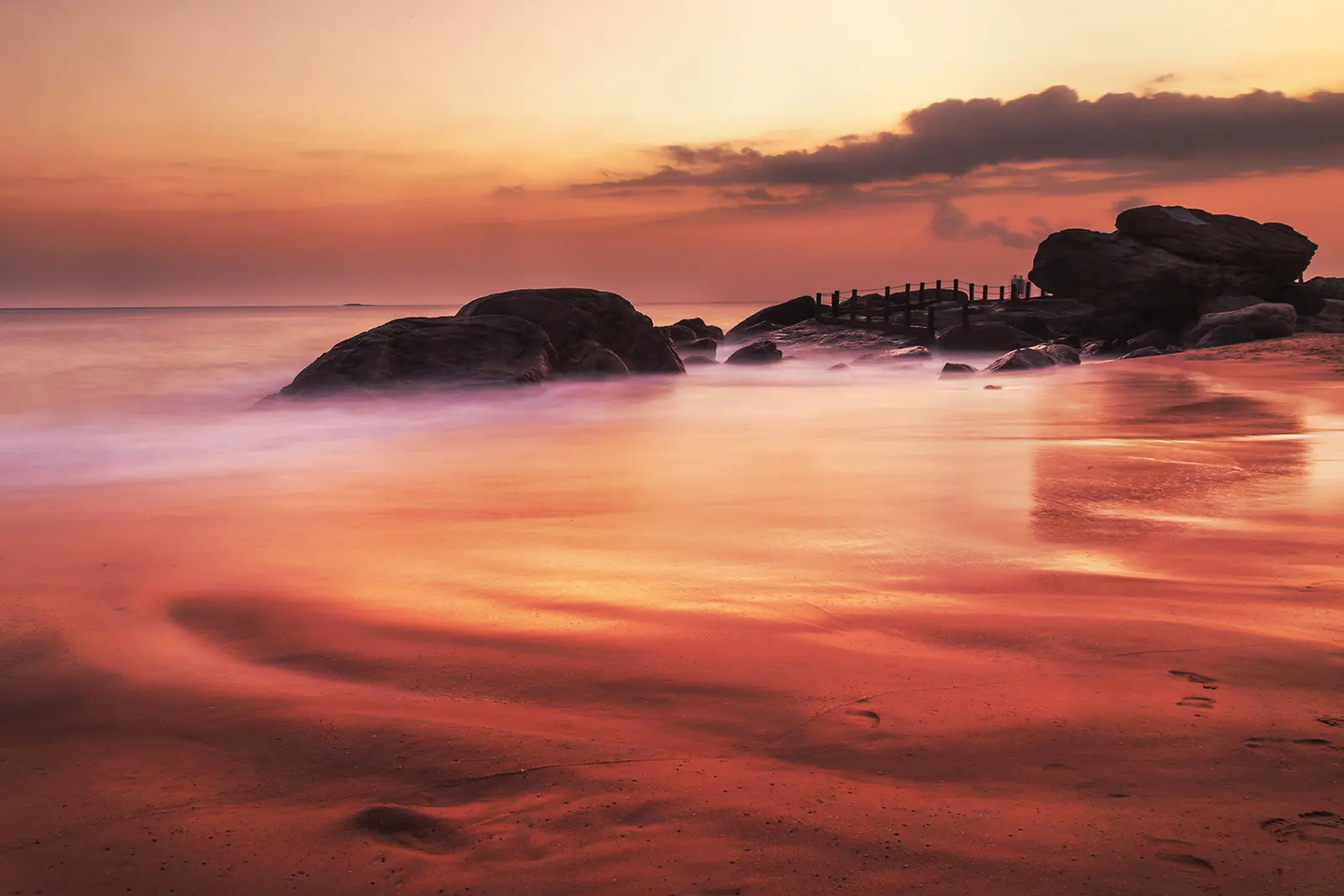
Muttom Beach: black rock, an old lighthouse and water you should not enter
Muttom is the most dramatic stretch of coast in the district and the most dangerous. The shore here is not sand but a mass of black rock, worn into shelves, pools and low cliffs, with the sea breaking white against it and a colonial-era lighthouse standing on the headland above. Between the rock sections are short beaches of coarse dark sand, and behind them is a working fishing village with boats drawn up and nets spread along the road. It is thirty-two kilometres west of Kanyakumari, about fifty minutes, and the drive down the last stretch to the sea is the moment most visitors decide they are glad they came.
It is also the place where we are most insistent with guests. The currents at Muttom are strong, the drop from the rock shelves into deep water is abrupt, and the sea pulls hard off the headland even on a calm-looking afternoon. People drown here, most years, and they are almost always visitors who waded in from a small beach that looked harmless. Do not swim at Muttom. Walk the rocks, climb to the lighthouse, watch the sun go down behind the headland, and keep out of the water. With that understood, it is one of the best two hours on the western coast and a complete change from the crowds at Kanyakumari town.
Why you must not swim here
The geography explains it. The headland at Muttom pushes out into the Arabian Sea and the coast on either side is a series of rock shelves with deep channels between them. Water pushed onto those shelves by the swell has to go back out somewhere, and it does so through the channels as a fast, narrow current that runs offshore. The small beaches between the rocks look sheltered, which is the trap: they sit at the head of exactly those channels. The bottom shelves steeply, and a person standing waist deep can be off their feet and moving in seconds.
There are no lifeguards at Muttom, no flags, no rope lines and no boat on standby. The fishing community knows the water and will shout at visitors who go in, which is worth heeding rather than resenting. Local people bathe in one or two specific spots at particular states of the tide and they do not generalise from that. The honest guidance is simple: paddle at the edge on the sand sections if you must, keep children by the hand and well back from the wet rock, and do not go in past your knees anywhere. Wet rock at Muttom is also slippery beyond what the surface suggests, with a thin algal film that looks dry, so the rule about staying back from the edge applies to walkers as much as swimmers. If you want to swim on this coast, go to Sanguthurai, which is calm and shallow.
The lighthouse and the headland
The lighthouse on the Muttom headland dates from the colonial period, put up in the middle of the nineteenth century to mark this corner of the coast for shipping rounding the cape, and it still works. It is open to visitors for a short window in the afternoon, generally 3 pm to 5 pm, closed on public holidays, with a ticket of ₹20 and a camera charge of ₹25. The staircase inside is a tight spiral and the last section is a steep ladder to the gallery; it is not for anyone with a problem with heights or knees. From the gallery you see the whole western coastline, the rock shelves below, the fishing boats and, on a clear day, a long way up towards Kerala.
The headland itself is free and open all day, and for many people it is better than the climb. A path runs from the parking area out along the top of the rock, past the lighthouse compound wall, to a point where the sea is on three sides and the swell breaks a hundred feet below. There are no railings, so stay well back from the edge, particularly with children and particularly in wind. This is where to be at 5:30 in the evening. The light at that hour turns the black rock warm and the whole coast to the north-west catches the sun. Photographers get more here in twenty minutes than in an afternoon almost anywhere else in the district.
The village, the boats and the ruins on the shore
Muttom is a working fishing village, one of the older ones on this coast, and walking through it is part of the visit. Boats are drawn up on the beach and the road, nets are laid out for mending in the mornings, and the catch comes in early and again in the late afternoon. If you are there between about 4 and 6 you will see the landing, which is brisk and worth watching from a distance. Ask before photographing people at work; most will not mind, some will, and the difference costs you nothing.
On the shore near the headland are the remains of old structures, including the ruined walls of what local people describe as a colonial-era building, half swallowed by sand and rock, and there is a small church and a set of steps down to the water that are older than they look. Muttom was on the coastal trade route long before it was a lighthouse station, and the layers show. There is little in the way of formal explanation and nothing signposted, so this is looking rather than learning. The village has tea shops and one or two small eating places serving fish curry meals for about ₹120, which is better food than anything on the tourist strip in Kanyakumari, though the surroundings are basic. There are no proper toilets for visitors, which is the site’s biggest practical failing.
Timing, seasons and crowds
Come in the late afternoon. Muttom faces broadly west, so the light between 4 and 6:30 is the point of the visit, and the lighthouse only opens at 3 anyway. A good sequence is to arrive at 3:30, do the lighthouse first while it is open, walk the headland and rocks from 4:30, and stay for sunset at about 6:15 in winter or 6:45 in summer. Mornings are fine for the rocks and the village but the sun is behind you and the sea is flat-lit. Midday is hot and there is no shade anywhere on the headland.
Seasonally, October to March is the best window, with clear air, moderate swell and comfortable evenings. From June to September the south-west monsoon puts a heavy swell onto this coast, the sea is brown and loud, and the rock shelves are being washed over regularly, which is spectacular from a safe distance and absolutely no place to walk out on. April and May are hot but the sea is calmest. Crowds are not really a problem: Muttom gets local visitors at weekends and in the evenings, a steady trickle of couples and photographers, and almost no tour buses. Even at sunset on a Sunday you will not be standing shoulder to shoulder. It is the opposite of the sunset crowd in Kanyakumari town, which is much of its appeal.
Getting there and fitting it into a day
The drive from Kanyakumari runs through Nagercoil and then west on the coastal road through Colachel towards Muttom, about 32 km and fifty minutes. It is an easy road. The last two kilometres go through the village and are narrow, with nets and boats on both sides, so drive slowly. Parking is informal near the headland at about ₹20. Buses run from Nagercoil to Muttom every twenty minutes or so for around ₹25, and the stand is a five-minute walk from the shore.
The natural pairing is with Colachel, 8 km away, where the Travancore forces defeated the Dutch in 1741 and there is a memorial pillar on the shore, and with Padmanabhapuram Palace, which is 20 km inland and works as the morning half of the same day. A full day of palace, lunch, Colachel and Muttom for sunset is about 110 km and fits the local rate of ₹2,800 in a sedan or ₹4,200 in an Innova Crysta, with driver, fuel and parking included. Coming back to Kanyakumari after sunset takes an hour on a dark road, which our drivers do routinely; if you are self-driving, allow more. Muttom also makes a good stop on the way back from a Kerala trip.
Six things our drivers tell every guest
- Do not swim. The channels between the rock shelves run offshore fast and the small beaches sit at the head of them.
- Arrive by 3:30 if you want the lighthouse. It opens only from 3 pm to 5 pm and shuts on public holidays.
- Stay back from the edge on the headland. There are no railings and the algal film on the rock looks dry.
- Be on the rocks between 5 and 6:30 pm. West-facing light on black rock is the reason to come.
- From June to September the swell washes over the shelves. Watch from high ground and stay off the lower rock.
- Eat in the village. Fish curry meals for about ₹120 beat anything on the Kanyakumari tourist strip.
How to get here
Muttom Beach is 32 km from Kanyakumari town, 50 min. It is included in our 2 days 1 night package and our 3 days 2 nights package, or we can add it to any local sightseeing day by the hour.
Questions about Muttom Beach
Nearby places to add to the same day
 35 km
35 kmAsia’s largest wooden palace, 35 km up the Thuckalay road. Closed Mondays.
Padmanabhapuram Palace is 35 km from Kanyakumari, open 9 am to 4.30 pm, closed Mondays. Entry ₹35, camera ₹50. The Mantrasala and granite bed explained.
 9 km
9 kmSanguthurai Beach
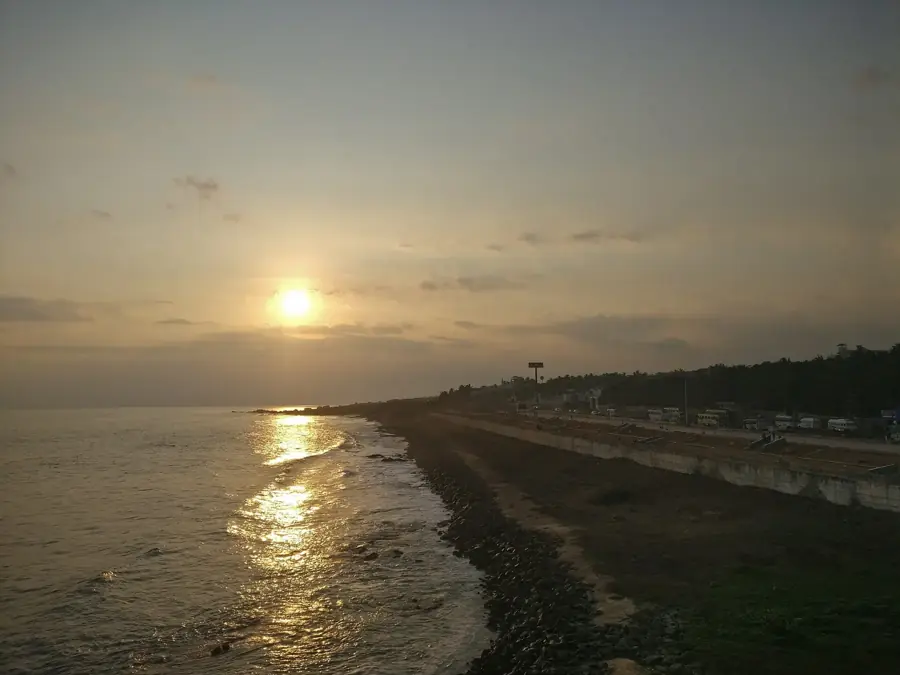
Sanguthurai Beach is 9 km from Kanyakumari, a calm local beach with a park and shallow water. Free, twenty minutes by car, best after 4.30 pm.
 7 km
7 kmVattakottai Fort
An 18th-century granite sea fort 7 km from Kanyakumari, built under Marthanda Varma’s Dutch commander De Lannoy, ASI-protected, best seen late afternoon.
Want Muttom Beach at the right hour?
We know when the queue is short and when the light is good. One message and it is in your plan.